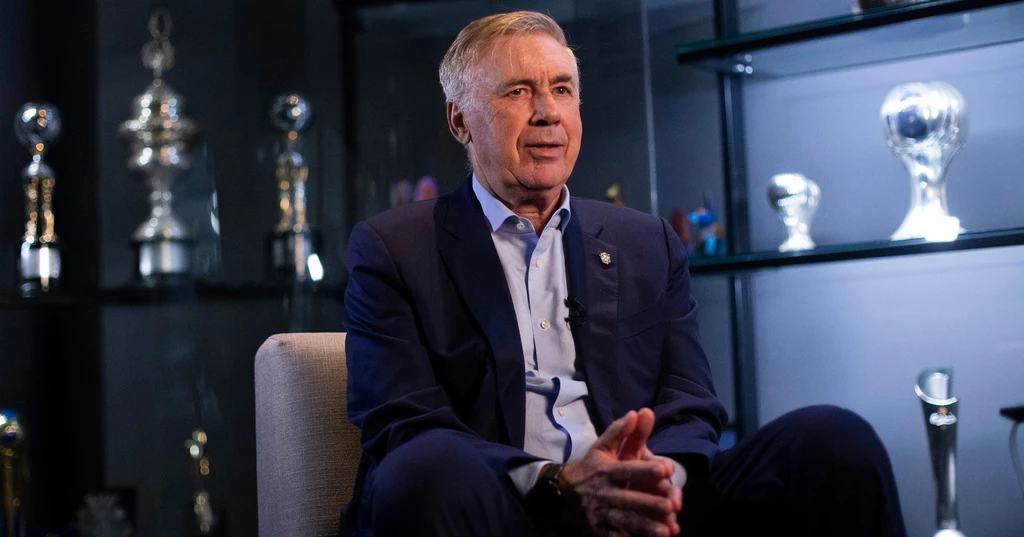
Brazil coach Carlo Ancelotti is still coming to terms with his team's round-of-16 defeat to Norway in the World Cup.
But as the 67-year-old Italian looks ahead to the next four years in charge, he plans to closely monitor youth-level players and Brazil's squad at the 2028 Los Angeles Olympics as part of an overhaul of the national team.
In an exclusive interview with The Associated Press at the headquarters of the Brazilian soccer confederation in Rio de Janeiro, Ancelotti also said the five-time World Cup champions do not need to copy defending champions Spain or a powerful France side to win a record sixth title.
"We don't need to copy — we need to learn where we can improve," Ancelotti said at the confederation's museum, which houses much of Brazil's national team silverware.
"Some positions are well-covered, both in defense and attack. We are looking for improvement and development among the midfielders. And the Olympics could be a crucial moment (to find players)," he said.
Ancelotti, who returned to Brazil on Sunday, has heard plenty about the Tokyo Olympics gold-medal match since taking charge. Five years ago, Brazil beat Spain 2-1 to retain the title.
Eight Spanish players from that match, along with coach Luis de la Fuente, have since become World Cup winners. Brazil, however, took only midfielder Bruno Guimaraes and striker Matheus Cunha to the 2026 World Cup.
"We are in contact with the U-15, U-17, and U-20 coaches to identify talent and track their progress, ensuring they are prepared for the next World Cup," Ancelotti said.
"Four years ago, Rayan was playing U-17. It is vital to look at youth development now so that by 2030 we have another generation of players progressing like him," he said.
Many Brazil fans may not be willing to wait that long, as they often expect star players to deliver and take leading roles wherever they play. But Ancelotti said the approach he is planning will be different.
"At this moment, football doesn't need one single star — we need to reinforce the concept of the team," he said.
"Brazil doesn't have a single reference point right now, and it doesn't need one. We have many great players. The goal is to build a strong, cohesive team."
New path for Brazil begins in September
Three friendlies — two against Australia in September and another against India in October — will mark the beginning of a new cycle for Brazil's first full-time foreign coach.
Ancelotti knows pressure will remain high through the 2028 Copa America. He said a combination of players who make the continental tournament squad and younger players who travel to Los Angeles could form the core of Brazil's 2030 World Cup team.
Striker Neymar, who was included in Ancelotti's squad for this summer's tournament despite serious doubts over his fitness, is not part of the coach's plans going forward.
The 34-year-old star said earlier this week that he believes his time with the national team is over.
"That's part of the natural trajectory of a great talent like Neymar," Ancelotti said. "It is like it is for others who finish an important time with the national team. We spent little time together, but I have only good things to say. He was serious, professional, he helped in whichever way he could. Too bad he had this injury that did not allow him to be 100% since the first game."
Ancelotti said his decision to remain Brazil coach until 2030, while turning down an offer from the Italian soccer federation to coach the national team he once played for, "has nothing to do with contracts, it has to do with commitment."
Italian soccer officials had considered Ancelotti for the position, which ultimately went once again to Roberto Mancini.
"The Brazilian soccer confederation has always supported me, especially after the defeat against Norway," Ancelotti said in his increasingly fluent Portuguese, which he has learned from a teacher and a language app.
"The commitment I have is because of the reception I had here this year," he said.
Ancelotti has experienced the pain of losing a World Cup final with Italy — against Brazil in a penalty shootout in 1994, when he was an assistant coach of the Azzurri.
But he said the latest defeat hurts more, although it has also broadened his outlook toward 2030.
"It is a tough time to digest this defeat. I was used to defeats at clubs because you can seek payback quickly. Now I have to wait. Sometimes I think about the defeat more than usual," Ancelotti said.
"You have to have the strength to have an eye in the past and another one in the future. Each day that goes by I am thinking more about the future than the past."