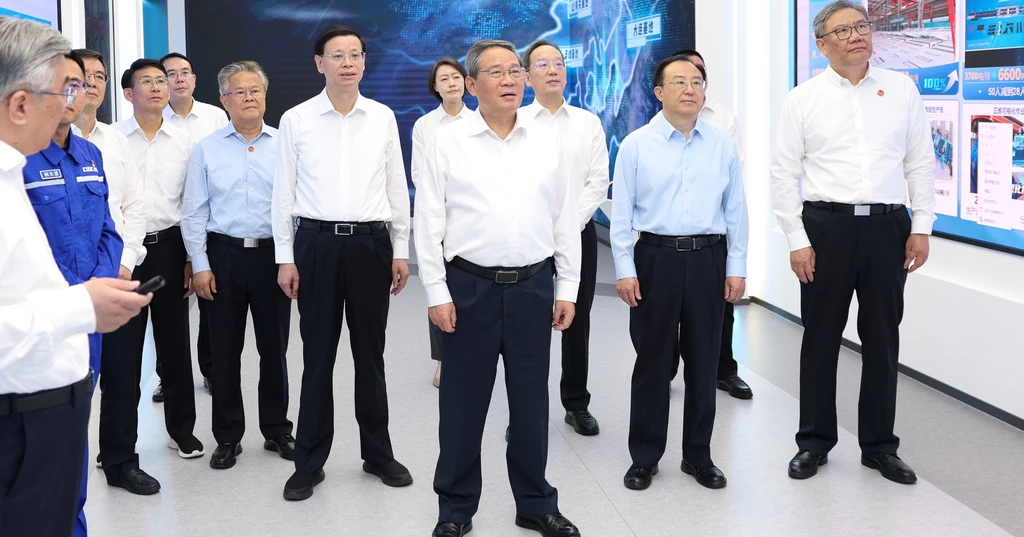
Chinese Premier Li Qiang on Wednesday defended China's rapid technological advancement, saying the country's innovations should be viewed as an opportunity for the world rather than a threat.
Speaking at the opening session of the World Economic Forum's Annual Meeting of the New Champions, also known as the "Summer Davos," in the northeastern Chinese city of Dalian, Li said growing concerns over China's technological rise were misplaced.
He acknowledged that some countries have described China's high-tech expansion as "China Shock 2.0," seeing it as a challenge to advanced economies.
Instead, Li said it should be regarded as "China Opportunity 2.0."
"From the global development perspective, 'China Opportunity 2.0' means there'll be broader access to advanced technologies and more widely shared benefits," he said.
"China's emerging technologies and products are bringing to the world not shocks, but opportunities; not threats, but empowerment," he added.
China's growing exports of electric vehicles, solar panels, semiconductors, batteries, artificial intelligence technologies and robotics have provided affordable products to global markets, but they have also sparked criticism from governments concerned about overcapacity and unfair competition.
Li also rejected claims that China's technological rise has been driven primarily by extensive state subsidies.
The United States and European countries have repeatedly accused Beijing of giving unfair advantages to its industries through state support. Earlier this month, a report by the Organization for Economic Cooperation and Development (OECD) said massive government subsidies, including those in China, can distort global markets and create unfair competitive advantages.
"There are some people who say that Chinese products are competitive mainly because of the Chinese government's subsidies. That's not true. The Chinese government is not that wealthy," Li said.
He argued that China's vast domestic market of 1.4 billion people, which enables the rapid adoption of new technologies, along with strong corporate investment, has been a major driver of the country's technological progress.
Li cited Chinese technology giant Huawei and robotics firm Unitree as examples of the country's innovation success.
Both companies have recently faced increased scrutiny from the United States. Earlier this month, the Pentagon expanded its list of Chinese companies allegedly linked to the military, adding Unitree and several other technology firms. The designation bars the companies from securing US defense contracts. Huawei is also included on the list.
Beijing has strongly opposed the move, saying it unfairly targets Chinese companies.