
A new artificial intelligence model developed by Chinese startup Moonshot AI has drawn attention across the global technology industry, with experts saying it rivals leading AI systems from OpenAI and Anthropic and underscores China's rapid progress in the field.
Moonshot on Friday unveiled Kimi K3, an open-source large language model that analysts say performs on par with some of the most advanced versions of OpenAI's ChatGPT and Anthropic's Claude, raising fresh competition for major US AI companies.
Anastasios Angelopoulos, co-founder and CEO of AI evaluation platform Arena, described K3 as one of the year's most significant AI releases, saying the model had topped Arena's rankings for front-end coding capability and could signal that open-source Chinese models are beginning to outperform some closed US systems.
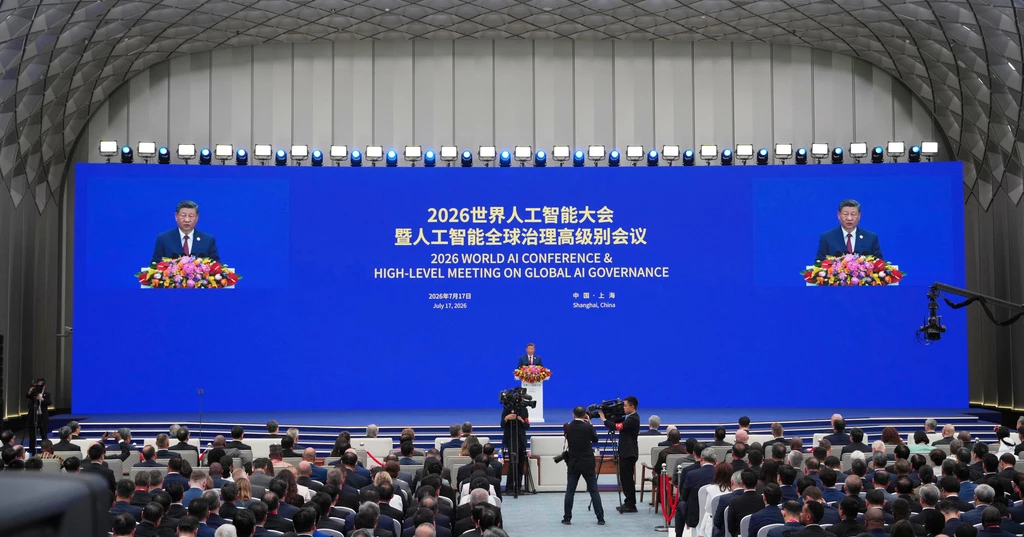
The launch coincided with the opening of China's annual World Artificial Intelligence Conference in Shanghai, where President Xi Jinping called for greater international cooperation in AI development rather than competition dominated by any single country.
China has accelerated efforts to strengthen its domestic AI capabilities in response to US export restrictions on advanced technologies, particularly high-end semiconductor chips.
Kimi K3 follows the recent release of another advanced Chinese AI model by startup Zhipu (Z.ai), whose GLM-5.2 model has gained popularity among software developers for delivering strong performance at lower costs than many leading US alternatives.
The emergence of K3 has drawn comparisons with the release of DeepSeek's AI model earlier in 2025, which rattled global technology markets. While some analysts believe the latest excitement may be overstated, others say it highlights growing competitive pressure on American AI firms such as OpenAI and Anthropic.
Alongside the conference, Chinese technology giant Huawei showcased its Atlas 950 SuperPoD AI computing platform, highlighting Beijing's push to build domestic AI hardware despite US restrictions on imports of advanced chips from companies such as Nvidia. Moonshot is reported to be a Huawei partner, although it has not disclosed the hardware used to train K3.
Despite being the most expensive Chinese AI model to date, K3 still costs about half as much to use as OpenAI's premium GPT-5.6 Sol model, according to a Bank of America research report.
The rapid rise of Chinese AI models has also intensified tensions with US companies. OpenAI and Anthropic have accused several Chinese AI developers, including Moonshot, DeepSeek and MiniMax, of using "distillation" techniques to extract capabilities from their models without authorization. Chinese authorities have rejected the allegations as unfounded.
Distillation is a widely used AI training method, but US firms argue it becomes problematic when competitors use it to replicate advanced capabilities at significantly lower cost and development time.
Meanwhile, AI innovation continues to flow in both directions. US startup Anysphere acknowledged that one of its popular coding tools was built using Moonshot's earlier K2.5 model, illustrating the growing influence of Chinese open-source AI technology on global software development.
Moonshot CEO Yang Zhilin, who earned his PhD at Carnegie Mellon University in 2019, has been recognized by former colleagues for his contributions to machine learning. His latest achievement has also been welcomed by supporters of open-source AI, who argue that publicly accessible models help accelerate innovation, although critics continue to warn about potential security and safety risks associated with making powerful AI systems widely available.