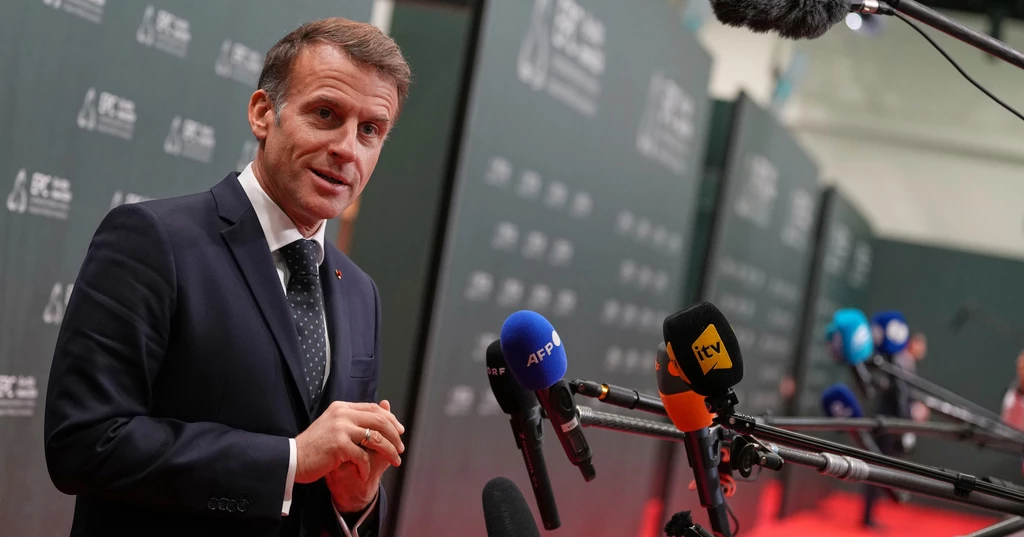
French President Emmanuel Macron is set to attend a biennial summit of French-speaking nations in Cambodia beginning Saturday, where tensions over an African conflict could complicate diplomatic discussions as he faces political challenges at home.
The three-day gathering, organised by the International Organisation of La Francophonie (OIF), will continue until Monday in the Cambodian capital, Phnom Penh.
Macron is expected to hold bilateral talks and participate in the summit of the organisation, which brings together 90 member states and governments, including 53 full members, five associate members and 32 observers where French is spoken.
Cambodia will assume the rotating presidency of the organisation from Macron, who chaired the previous summit in 2024 when France hosted the gathering.
Before leaving for Malaysia on Monday, Macron is also scheduled to visit the Angkor World Heritage Site near Siem Reap, where he and King Norodom Sihamoni will mark the completion of the French-supported restoration of the West Mebon temple.
His visit comes amid widespread protests in France. The country's Interior Ministry reported that more than 600,000 people took to the streets earlier this month, demanding higher wages and expressing support for the student protest movement, which has led to thousands of arrests, hundreds of injuries and the burning of schools.
Conflict in eastern Congo threatens to divide summit
One of the most sensitive issues facing Macron and other leaders will be the selection on Monday of the organisation's next secretary-general, who will serve a four-year term as its chief executive.
The leading contenders represent two African nations locked in a bitter dispute: Rwanda's Louise Mushikiwabo, who is seeking a third consecutive four-year term, and Juliana Lumumba, 71, from the Democratic Republic of Congo. She is the daughter of Patrice Lumumba, the country's assassinated independence leader.
Congo, the United States and UN experts have accused Rwanda of supporting the M23 rebel group, one of around 100 armed organisations competing for control in mineral-rich eastern Congo along the Rwandan border. Rwanda has repeatedly denied providing support to armed groups operating in Congo.
The Congolese government has threatened to withdraw from the OIF if Mushikiwabo secures another term.
With a population of more than 110 million, over 40 million larger than France's, Congo is the world's most populous country where French is an official language. Its departure would therefore represent a major setback for the organisation.
Two other contenders, from Romania and Mauritania, are also being considered as possible compromise candidates.
France is expected to play an influential role in the selection process as the organisation's largest financial contributor. The OIF's budget for 2026 stands at €71.7 million ($79 million).
The leadership contest could further complicate the summit following the withdrawal of Mali, Niger and Burkina Faso from the organisation, announced in March 2025 after their memberships were suspended over military coups.
Mali argued that the suspensions violated its national sovereignty. The withdrawals also reflected a broader trend among French-speaking African countries seeking to distance themselves from what they consider excessive French political, military and cultural influence.
Cambodia hosts international leaders
The summit's theme, "Reinvest in Peace for Shared Prosperity and Lasting Stability," is viewed as reflecting Cambodia's recovery from decades of conflict and political turmoil during the final quarter of the 20th century.
Around 20 heads of government and state are expected to attend, including Canadian Prime Minister Mark Carney, Vietnamese leader To Lam, Rwandan President Paul Kagame and Congolese President Félix Tshisekedi.
They are also expected to meet Cambodia's King Norodom Sihamoni and Prime Minister Hun Manet.
Most items on the summit's agenda are considered relatively uncontroversial. Documents scheduled for approval will address commitments to peaceful coexistence, social, cultural and economic cooperation, crisis resolution, peace-building, cultural heritage protection and the promotion of cultural diversity.
Cambodia is also using the gathering to highlight its tourism potential and investment opportunities through side events focusing on commercial partnerships, cultural exchanges, science and technology.
However, local political activists see the international gathering as an opportunity to push for greater democratic freedoms in the country, which effectively operates as a one-party state.
UN Special Rapporteur Tom Andrews has urged summit delegates to uphold the organisation's principles and press the Cambodian government to release detained human rights activists.
"No one should be detained for defending human rights, reporting on matters of public concern, or voicing critical opinions," he said in a statement.
Cambodia has historical ties to the establishment of the Francophonie organisation. Its late king and independence leader Norodom Sihanouk was among the four founders of the Agency for Cultural and Technical Cooperation in 1970, the predecessor of the OIF.
However, following Sihanouk's overthrow, his immediate successors did not join the organisation as the country descended into civil war and subsequently endured the brutal rule of the communist Khmer Rouge between 1975 and 1979.
Cambodia joined the Francophonie as an observer in 1991 before becoming a full member in 1993.