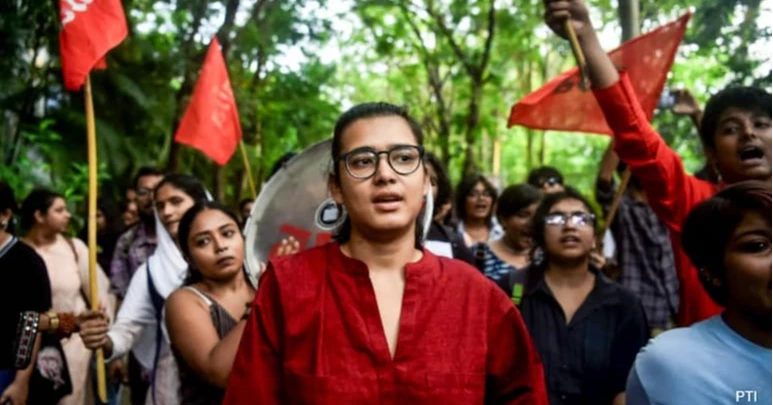
India’s ruling Bharatiya Janata Party (BJP) has seized on student leader Neha Bora’s remark that Bangladesh inspired the Gen Z movement in India, with party national spokesperson Pradeep Bhandari describing it as an “open admission of regime change”.
Bora, 29, studied at Delhi University before pursuing a doctorate at Jawaharlal Nehru University’s School of Arts and Aesthetics.
In an undated interview, she said the Gen Z movement currently unfolding across India had first emerged in Bangladesh, a strategic partner of New Delhi and a key ally in securing its borders, particularly in the northeastern states.
"The Gen Z movement we are seeing everywhere in this country first started in Bangladesh and congratulations to you for showing us the way and extending solidarity to the young people of this country," she is heard saying in the clip shared by the BJP leader.
Bangladesh Prime Minister Sheikh Hasina was ousted on August 5, 2024, following weeks of student-led protests that escalated into deadly nationwide unrest.
Drawing parallels between the two countries, Bora said both movements were fighting for the restoration of “democratic and voter rights”. In India, protests have been taking place against Chief Election Commissioner Gyanesh Kumar over alleged electoral malpractices.
"We know that the movement that began in Bangladesh was for democratic and voter rights. Today the movement that the young people are participating in and leading is also a movement for democratic and voting rights," she said.
"We know that the fight that you fight against religious fundamentalism in your country is also the fight that Gen Z and the young people of this country are fighting today," she added.
Bhandari cited the video to support his allegation that the Congress-led opposition was seeking to replicate the events in Bangladesh.
"Rahul Gandhi and his entire ecosystem do not wish to offer mere political resistance; they aim for regime change. In an interview, Neha Bora stated that she is inspired by the Gen Z-led movement in Bangladesh, and they intend to replicate in India what took place in Bangladesh," Bhandari, who is aggressively shouting in the video, claimed.
"This proves that Rahul Gandhi's objective is not political resistance; rather, his goal is to destroy the Constitution and democracy within India. It demonstrates that the entire Congress ecosystem is solely focused on dismantling Indian democracy and orchestrating a regime change, similar to what happened in Bangladesh. Rahul Gandhi and the Congress ecosystem pose a danger to Indian democracy, and everyone who believes in Indian democracy should oppose him," Bhandari, a former journalist, added.
In the same interview, Bora expressed hope that the two South Asian countries could work together for a better future for the region and the world.
"And we hope that together you in Bangladesh and we in India can fight together for a better south Asia for a better world," she said.
Earlier this week, Bora joined leaders of the Rahul Gandhi-led Opposition INDIA bloc in a march to the Supreme Court against Chief Election Commissioner Gyanesh Kumar.
At a subsequent press conference, Gandhi rejected the suggestion that the protests should be treated as separate demonstrations, describing them as “one protest”.
"All the protests are one protest. There are no parallel protests and the idea is India is marching. We do not care who you are, which formation you come from, if you are protecting the constitution, as we are, we are with you, we will help you, we will support you, we will protect you and expect the same from you. This is an expression of our love for Indian people," Gandhi had said.
Known for her soft-spoken manner in conversation and forceful speeches at public gatherings, Bora has attracted a following through addresses in Hindi and English. She frequently invokes constitutional rights and connects student grievances with broader concerns over inequality and government accountability.
She drew wider attention during protests in July over alleged examination paper leaks, joining other activists in demanding the education minister’s resignation. Her speeches at Jantar Mantar, a historic protest site, criticising the government and police response to demonstrators, subsequently circulated widely online.
Since then, Bora has become a regular presence at demonstrations in the Indian capital. During protests seeking the resignation of Chief Election Commissioner Gyanesh Kumar, she was repeatedly detained and returned to the streets after being released.
Bora has said that ideology alone does not drive the current mobilisation, arguing that hope is an even more powerful force.
"Fear is infectious, of course. But hope is also infectious," she told news agency Reuters. "People have courage now because they think that they can have courage."
She said the demonstrations reflected years of accumulated grievances.
Source: NDTV