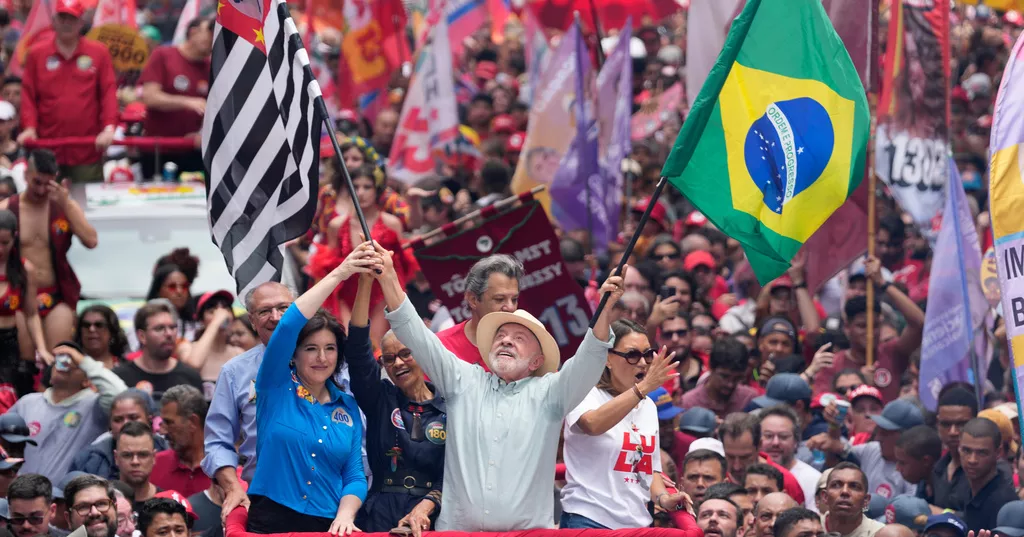
Brazilian President Luiz Inacio Lula da Silva and opposition presidential candidate Sen. Flavio Bolsonaro campaigned Saturday in the key state of Sao Paulo, seeking to rally supporters and win over undecided voters a day before Sunday's presidential election.
Lula, seeking a fourth nonconsecutive term, joined a traditional pre-election parade in Sao Paulo city, while Bolsonaro, the son of former President Jair Bolsonaro, campaigned in the countryside cities of Santa Barbara d'Oeste and Americana.
Sao Paulo is Brazil's most populous and economically powerful state, with about 46 million residents and around 34 million eligible voters. Its annual gross domestic product is about 3.4 trillion Brazilian reais, or $650 billion.
Addressing supporters near Paulista Avenue, Sao Paulo's main thoroughfare, Lula described the election as a crucial battle over Brazil's future.
"On one side, we have democracy and sovereignty; on the other, barbarism and corruption," Lula said, repeating key themes of his campaign.
Former President Jair Bolsonaro was sentenced by Brazil's Supreme Court last year to 27 years in prison for attempting a coup after losing the 2022 election to Lula. Observers say he could potentially be released if his son wins the election.
Lula's campaign has also portrayed Flavio Bolsonaro as a threat to Brazil's sovereignty because of his close ties with US President Donald Trump. Trump last year imposed a 50 percent tariff on Brazilian imports over Jair Bolsonaro's trial, which Trump described as a "witch hunt."
Daniella Fernandes, a 32-year-old secretary at a public school in Sao Paulo, said she had initially wanted another Workers' Party candidate to run instead of Lula but changed her mind during the campaign.
"I wanted some renovation, but Lula is the only one who can appeal to everyone — even those who are not on the left," she said, wearing several Lula badges.
"The Bolsonaros are still strong, Brazil is a conservative country. Only Lula can win this one," Fernandes said.
About 140 kilometres from Lula's campaign event, Flavio Bolsonaro travelled through Santa Barbara d'Oeste and Americana on a sound truck, accompanied by a long procession of supporters wearing yellow and green and riding motorcycles.
"I'm convinced that we can win in the first round," Bolsonaro told supporters, who shouted "mito," or "legend," a term used by his father's supporters.
"So let's get out of our houses to vote (...) because Bolsonaro is going to be president," he said.
Bolsonaro was accompanied by Sao Paulo Gov. Tarcisio de Freitas, who had previously been considered a possible political successor to Jair Bolsonaro before Flavio said last December that his father had chosen him to contest the presidential election.
Voters on Sunday will also elect federal and state lawmakers, governors and some senators. In Sao Paulo, de Freitas is seeking re-election against opposition candidate Fernando Haddad, who lost the 2018 presidential election to Jair Bolsonaro and later served as Lula's finance minister. De Freitas holds a substantial lead in opinion polls.
Twelve candidates are contesting the presidency, but Lula and Flavio Bolsonaro are widely seen as the only candidates with a realistic chance of winning.
If no candidate secures more than 50 percent of the vote, the top two will face each other in a runoff on Oct. 25.
The two leading candidates represent sharply different political positions, with contrasting approaches to issues including organised crime and Brazil's relations with the Trump administration.
Lula, a former factory worker and trade union leader, lost his left pinky finger in a workplace accident at age 19. He has long enjoyed strong support among sections of the population.
He spent more than a year in prison after being convicted on corruption charges, but those convictions were later annulled. He subsequently won a third nonconsecutive presidential term in 2022.
Lula has pledged to ensure Brazilians benefit from the country's rare minerals and natural resources, protect the Amazon rainforest and continue his flagship Bolsa Familia welfare programme.
Flavio Bolsonaro has largely adopted his father's ultra-conservative agenda while at times using a more moderate tone to attract centrist voters.
His campaign has placed strong emphasis on tough security measures, which polls indicate have significant public support.
He has pledged to combat organised criminal groups by building megaprisons modelled on those in El Salvador, follow the Trump administration's approach of designating transnational gangs as terrorist organisations, and lower the age of criminal responsibility to 16.