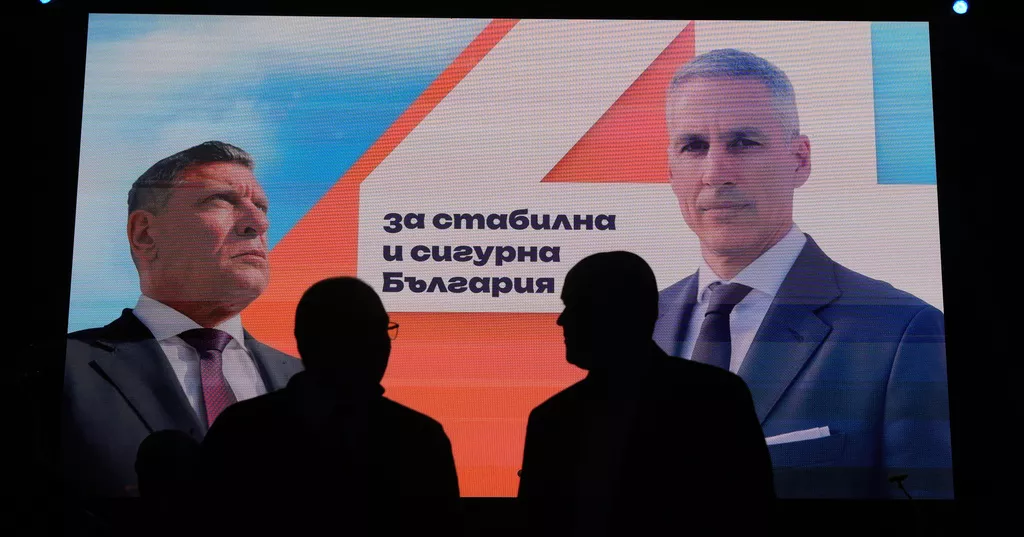
Bulgaria's presidential election is heading for a runoff on November 1 after a record-low voter turnout left the first round inconclusive, with pro-Western opposition candidate Andrey Gyurov performing stronger than expected against incumbent President Iliana Yotova.
The contest has exposed deep divisions over the country's foreign policy, particularly its relations with Russia and its support for Ukraine, amid growing public frustration with politicians and widespread voter apathy.
Bulgarians went to the polls on Sunday in an election shaped by mounting economic difficulties and security concerns following drone attacks on commercial vessels in the Black Sea.
The vote also marked the first major test for Prime Minister Rumen Radev's Moscow-friendly Progressive Bulgaria party since its victory in the parliamentary election in April.
With 27 candidates in the race, neither Yotova nor Gyurov was expected to secure an outright victory in the first round. Projections put voter turnout below 40%, well short of the threshold of more than 50% of the country's 6.6 million registered voters required for the election to be decided in the first round.
Initial exit polls were expected after polling stations closed at 8pm, with preliminary results due on Monday.
Yotova seeks her own mandate
Yotova, 62, a former journalist and member of the European Parliament, entered the election as the frontrunner. She previously served as vice president under Radev during his two terms as president.
She assumed the presidency in January 2026 after Radev stepped down to contest the parliamentary election. Now running as an independent, she has the backing of Progressive Bulgaria and the Socialist Party, where she began her political career.
If elected, Yotova would become Bulgaria's first directly elected female president.
Analysts expect her to broadly continue Radev's policy of keeping Bulgaria on its European path while advocating better relations with Russia and the lifting of sanctions against Moscow. Both leaders have called for a diplomatic settlement to the war in Ukraine.
Addressing supporters at a rally earlier this week, Yotova said she “advocated for peace through negotiations, rather than force”.
Observers warn that her victory could further concentrate power in the hands of the ruling majority, potentially weakening institutional checks and balances on government decisions.
Gyurov offers pro-Western alternative
Gyurov, an economist and former deputy governor of Bulgaria's central bank, served as caretaker prime minister during the early months of 2026. He is backed by pro-Western reformist opposition parties.
A strong supporter of Ukraine, Gyurov signed a security cooperation agreement with Kyiv while serving as prime minister.
“I want Bulgaria to have a voice of its own in Europe. A reliable NATO ally that defends its interests through preparedness, strong diplomacy and a clear position,” he told supporters this week.
Recent opinion polls had placed Yotova ahead in the first round, with support ranging from 40% to 45%, compared with Gyurov's 25% to 30%. The margin of error was three percentage points.
However, some observers believe Gyurov could perform better in the runoff by attracting voters whose preferred candidates fail to advance from the first round.
War in Ukraine, economic hardship dominate campaign
Russia's invasion of Ukraine and growing hostilities in the Black Sea featured prominently in the campaign.
Recent drone attacks on commercial vessels off Bulgaria's coast have raised security concerns in the European Union and NATO member country. The incidents have fuelled fears that Russia could escalate the conflict and prompted the Bulgarian government to seek assistance from its international partners to strengthen maritime security.
Candidates also addressed public concerns over rising energy prices and inflation, which have placed increasing pressure on household budgets, particularly in rural areas.
Bulgaria elects its president directly for a five-year term, with a maximum of two terms allowed. Although the presidency is largely ceremonial, the direct mandate gives the office considerable political influence.
The president serves as commander-in-chief of the armed forces, can veto legislation, signs international treaties and appoints ambassadors.