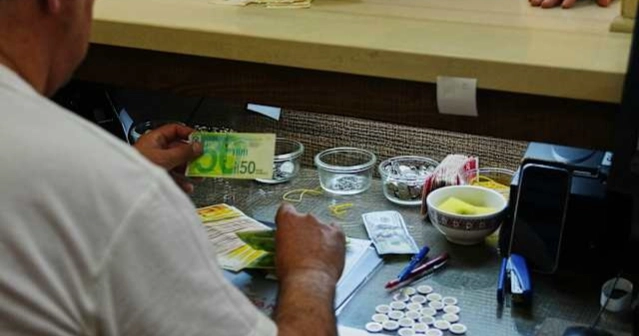
An unusual cash crisis is disrupting daily life in the Israeli-occupied West Bank, where banks are overwhelmed with more Israeli shekels than they can handle, making it difficult for businesses to deposit money and carry out routine financial transactions.
The problem has become so severe that some businesses are refusing cash payments because their banks are no longer accepting deposits of banknotes and coins.
Unlike most economies where cash shortages can create problems, Palestinian banks in the West Bank are running out of space to store huge amounts of physical currency.
Palestinian officials say the crisis stems from restrictions imposed by the Bank of Israel, which limits the amount of cash it accepts back from Palestinian banks. They argue that the cap has not been updated to match economic growth and has become another source of pressure on the territory's struggling economy.
As banks cannot return excess cash to Israel, they are unable to convert it into electronic funds needed for transfers, supplier payments and other financial transactions.
Mohammad Manasra, deputy governor of the Palestinian Monetary Authority, said the restrictions have severely limited the banking sector's ability to operate.
"The banks have been tied down," he told The Associated Press, describing the situation as a form of "economic warfare."
More cash enters than banks can return
The West Bank has relied mainly on the Israeli shekel for decades and depends heavily on Israel for trade, tax collection and payments for imported goods.
Large amounts of cash flow into the territory because many Palestinians working in Israel and Israeli settlements receive their wages in cash. Palestinian citizens of Israel also bring shekels into the West Bank when buying goods such as fuel and cigarettes.
Economist Moayad Afaneh, an adviser to the Palestinian Authority, said Palestinian banks now receive around 30 billion shekels annually, while Israel allows them to transfer back only 18 billion shekels (about $5.9 billion) each year.
Israeli authorities have previously said they limit cash transfers because of concerns about money laundering, tax evasion and terrorism financing.
The Bank of Israel said it follows government policy on cash transfers and noted that fewer Palestinians have been working in Israel since the Gaza war began, reducing some cash inflows.
Growing economic pressure
Palestinian officials say the cash restrictions are part of broader economic measures introduced by Israel since the Gaza war began in October 2023.
Israel has revoked most work permits for Palestinians employed in Israel and has withheld tax and customs revenues collected on behalf of the Palestinian Authority. As a result, the Palestinian Authority has struggled to fully pay salaries of public employees, including teachers and healthcare workers, for more than a year.
Banks are also facing rising costs as they spend more on storing and insuring cash that cannot be transferred out of the territory. Many have reduced the amount of cash they accept from businesses and individuals, forcing customers to find other ways to store their money.
Manasra said the cash surplus is affecting both government operations and private businesses.
Since most fuel, electricity and water used in the West Bank are purchased from Israel, customers need electronic payments to pay suppliers. However, banks with large amounts of idle cash often cannot process those transactions.
Afaneh said fears of Israeli military raids have encouraged more Palestinians to deposit cash in banks for safekeeping, adding further pressure on the banking system.
He also noted that excess cash has reduced banks' profitability because they cannot lend the money or invest it. An International Monetary Fund study in 2022 estimated the problem had cut bank profits by around 20%, although Afaneh believes the impact is now much greater.
Businesses struggle despite holding cash
The crisis has hit businesses that rely mainly on cash payments.
Hussni Jaber, executive manager of the Al-Huda Group, which operates fuel stations, supermarkets and other businesses, said companies are collecting millions of shekels every month but cannot deposit much of the money because banks have reached their limits.
To make electronic payments to suppliers, some businesses have had to take loans or exchange cash into other currencies while also paying more to safely store large amounts of money.
Jaber said some fuel stations have temporarily stopped selling fuel because they could not pay suppliers electronically. The Palestinian Authority also cited the banking crisis after several fuel stations temporarily closed on Saturday.
Last month, fuel station owners across the West Bank staged a 30-minute strike to highlight the problem, but business leaders say no solution has yet been offered.
Jaber warned that if the cash crisis continues, companies may struggle to import essential goods, including fuel, food and medical supplies.
"If this problem is not solved, all sectors of the economy could collapse," he said.