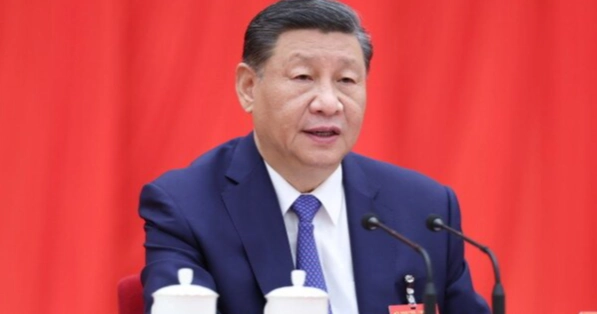
China's top political leaders began a four-day meeting on Monday to discuss stricter discipline within the ruling Communist Party as President Xi Jinping seeks greater loyalty and accountability from officials while continuing his long-running anti-corruption campaign.
The closed-door gathering, known as the fifth plenum of the Communist Party's Central Committee, comes about a year before Xi is widely expected to secure an unprecedented fourth five-year term as party leader. The meeting may also influence personnel changes within key leadership bodies.
Xi opened the meeting with a work report and discussed a draft policy decision aimed at advancing “full and rigorous party self-governance”, according to the state-run Xinhua News Agency. The proposed measures seek to make party officials more disciplined, efficient and less corrupt.
Although Xi has strengthened his hold on power, analysts say the meeting provides an opportunity to ensure that officials' actions more closely reflect Beijing's priorities.
“The plenum is a chance to ensure the new generations rising the ranks share Xi's assessment of the opportunities and risks China faces,” said Ruby Osman, a senior policy adviser at London's Tony Blair Institute for Global Change.
Xi targets corruption and poor-performing officials
Xi's anti-corruption drive has been a central feature of his leadership since he took power in 2012. Numerous officials, including some considered political rivals, have been removed or punished, prompting critics to argue that the campaign has also helped consolidate his authority.
However, the crackdown has increasingly targeted officials accused of poor performance and misconduct. In recent years, punishments for “formalism” and “bureaucratism” have risen sharply. These offences include neglecting responsibilities, failing to act and taking reckless decisions that obstruct development.
Analysts say Xi's latest proposals reflect his emphasis on the party's “self-revolution”, a concept involving internal reform through anti-corruption measures and stronger ideological commitment.
Osman said the disciplinary campaign was increasingly focused on maintaining the party's institutional strength over the long term.
“It's less about purging elite rivals and more about building a disciplined system that can sustain Xi's political priorities across leadership cycles,” she said.
She added that record numbers of disciplinary actions did not necessarily indicate rising corruption but could reflect increasingly demanding standards imposed on officials.
Mingda Qiu, a senior analyst with Eurasia Group's China practice, said Beijing had been preparing its agenda for months.
“The message is clear: the anti-corruption campaign is not winding down. Officials are not only tested for loyalty, but also for compliance and action,” he said.
According to an October article in Qiushi Journal, a Communist Party publication, Xi said in January that top-level decisions were generally being implemented smoothly. However, inspections and audits had identified failures to follow instructions and improper execution.
Xi also warned against “two-faced people” who publicly profess loyalty but privately ignore orders and act according to their own interests.
“During leadership transitions, we must keep our eyes sharp, elevate good cadres who are truly loyal and reliable, consistent in word and deed, and willing to take responsibility, and never allow 'two-faced people' or those driven by self-interest to slip through,” Xi was quoted as saying.
Military purges draw attention
The number of vacant seats at this week's meeting could provide an indication of the extent of Xi's purge of officials.
Neil Thomas, a senior fellow at the Asia Society Policy Institute, and his colleagues Lobsang Tsering and Shengyu Wang noted that 42 of the 44 military-affiliated officials elected as full members of the Central Committee in 2022 had been purged or disappeared from public view.
The Central Committee began its term in 2022 with more than 370 full and alternate members.
Thomas and his colleagues estimated that attendance at the meeting could fall below 80%, potentially marking the lowest turnout at a plenum since the end of former leader Mao Zedong's rule in 1976.
Observers will also examine whether the remaining officials face stricter requirements.
Thomas expects tighter monitoring of public expenditure and major projects, greater use of technology to detect corruption, and harsher penalties for officials who fail to implement Xi's priorities.
New appointments to leadership positions are possible, but Xi may postpone major decisions until next year's Communist Party Congress, which is held every five years, said Steve Tsang, director of the SOAS China Institute in London.
If vacancies are filled before then, Tsang expects the appointments to favour loyalists.
No clear indication of Xi's successor expected
The fifth plenum also provides another opportunity for Xi to prepare for a possible fourth term as China's leader.
Xi, who abolished presidential term limits in 2018, is regarded by some observers as China's most powerful leader since Mao. He is widely expected to be confirmed as party leader for another term in autumn 2027.
Thomas said the meeting could introduce new ideological language further reinforcing Xi's authority.
He added that the plenum was expected to lay the groundwork for another term under Xi and strengthen expectations of continuity in politics and policymaking.
“After Xi has purged so many of the people that he promoted at the last congress, watch for tougher scrutiny of the officials competing to join his next leadership team,” he said.