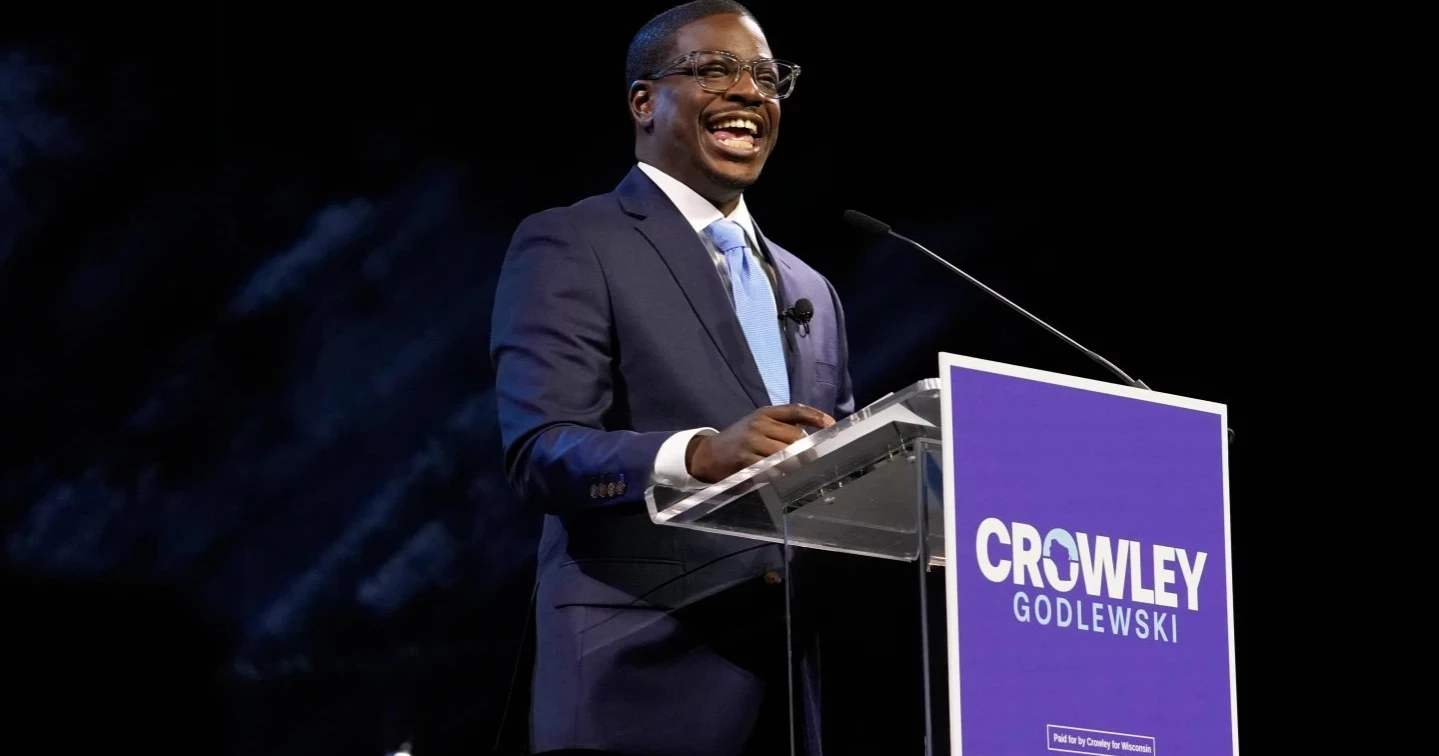
Democrat David Crowley defeated Republican US Rep. Tom Tiffany, a close ally of President Donald Trump, on Tuesday to become Wisconsin's first Black governor, marking a historic milestone in the battleground state's 178-year history.
Crowley, who grew up in one of Milwaukee's poorest neighbourhoods, will succeed outgoing Gov. Tony Evers, who decided not to seek a third term. His victory also marks the first time Wisconsin Democrats will retain the governor's office for more than eight consecutive years.
Speaking at his victory celebration, Crowley pledged to represent all Wisconsin residents, including those who voted against him, and called for cooperation across party lines.
"Wisconsin isn't a red state or a blue state," he said, stressing that neither party could govern the closely divided state alone.
The 40-year-old politician promised to work with both Democrats and Republicans to reduce living costs. Democrats were also seeking to regain control of the state Legislature, which they have not fully controlled since 2010.
Crowley's victory dealt a setback to Republicans' efforts to regain control of Wisconsin, which Trump won in two of his three presidential campaigns. The result also ensures Democratic leadership in the state during the next presidential election, when Wisconsin is expected to remain a key battleground.
Born on Milwaukee's north side, Crowley faced a difficult childhood as his parents struggled with substance abuse and housing evictions. He later became involved in community organising and politics, winning a seat in the state Legislature at 30.
After serving for just over three years, he was elected Milwaukee County executive in 2020.
His campaign for governor faced several challenges. Crowley initially withdrew from the race when his chances of securing the Democratic nomination appeared slim but returned after Evers encouraged him to run.
He subsequently defeated democratic socialist Francesca Hong in the August primary by less than half a percentage point before facing Tiffany in the general election.
Tiffany, 68, received most of his campaign funding from three billionaires and struggled with Trump's historically low approval ratings in Wisconsin. He had also survived a small plane crash while campaigning.
An open governor's race for the first time in 16 years
The Wisconsin governor's race was open for the first time since 2010 after Evers decided against seeking another term.
In 2010, Democratic Gov. Jim Doyle also declined to pursue a third term, allowing Republican Scott Walker to win the election. During his eight years in office, Walker implemented several Republican priorities, including restrictions on public-sector workers' collective bargaining rights, tax cuts and voter identification requirements.
Evers, who rarely endorses candidates in primary elections, backed Crowley to counter the growing campaign of Hong. Crowley ultimately secured the nomination by a narrow margin.
Wisconsin has a history of closely contested elections. Trump won the state in 2016 and 2024 but lost in 2020. Five of the state's past seven presidential elections have been decided by margins of less than one percentage point.
Evers defeated Walker by 1.1 percentage points in 2018 and secured re-election by 3.4 points in 2022.
Data centres and economic issues dominate campaign
During the campaign, Tiffany attempted to portray Crowley as a strong supporter of data centre development, calling him "Data Center David Crowley."
Tiffany also used a campaign advertisement featuring Crowley's remarks that Wisconsin could become a global hub for artificial intelligence and data centres.
However, Crowley changed his position late in the campaign, supporting a temporary halt to new data centre construction in October. Tiffany opposed such a moratorium.
Tiffany also accused Crowley of being weak on crime and claimed his policy proposals, including expanding healthcare and fully funding public schools, would lead to higher taxes.
Crowley, meanwhile, focused on economic concerns, blaming Tiffany's loyalty to Trump and support for the war in Iran for rising fuel prices affecting Wisconsin residents, particularly farmers.
He also pledged to overturn Act 10, a state law introduced 15 years ago that effectively ended collective bargaining rights for most public employees.
Tiffany had voted in favour of the legislation while serving in the state Legislature. He was elected to Congress in 2020 after representing a largely rural district in the Legislature for nine years.
Crowley's campaign also promised to expand Medicaid coverage, increase funding for public schools and improve access to childcare.