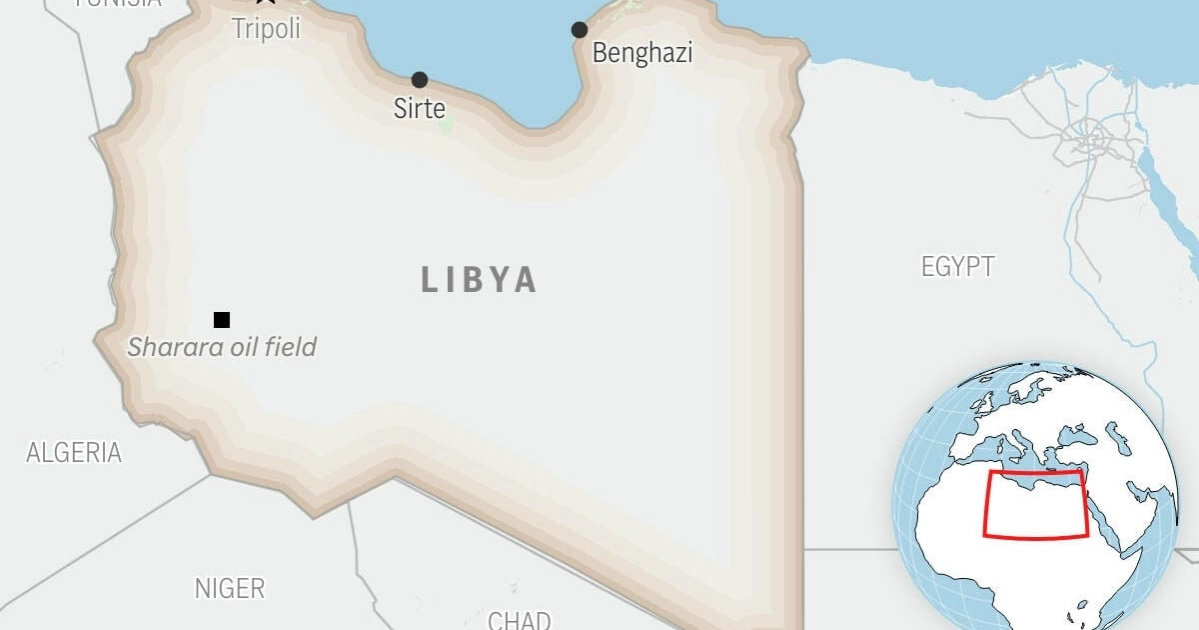
A drone strike on an oil facility in western Libya triggered a massive fire that firefighters were still battling Tuesday, while a car bomb killed a senior military officer in the country’s east, highlighting the continuing security crisis in the North African country.
The drone struck a gasoline storage tank at the Zawiya oil refinery on Monday in the Mediterranean city of Zawiya, about 47 kilometres west of the capital Tripoli, the state-run National Oil Corporation (NOC) said.
The strike set the fuel tank ablaze, with the fire continuing through the night and still burning by Tuesday noon, according to the Civil Defense agency.
Health authorities said there were no reports of casualties.
No group has claimed responsibility for the attacks on oil facilities in Zawiya or the car bombing in Benghazi on Monday.
Local media footage showed huge flames and fireballs rising from the tank, sending thick black and orange smoke into the sky as firefighters sprayed foam and water to put out the blaze.
While firefighters were tackling the fire, another drone struck near a key oil tank but caused no casualties or damage, the NOC said.
The company said the tank contained 4.5 million litres of fuel when it was hit and later collapsed. It declared the highest level of emergency at the facility.
Monday’s attack was the latest in a series of drone strikes targeting oil infrastructure in Zawiya, which hosts some of Libya’s key energy facilities, including the country’s largest oil refinery, an export terminal and a power plant.
The strikes came ahead of a planned visit to Libya by Turkish Foreign Minister Hakan Fidan, who is expected to travel to both Tripoli and Benghazi.
Over the weekend, the NOC said drone strikes had targeted a fuel tank and a desalination plant linked to the Zawiya oil facilities. The company said the fuel tank was damaged.
The attacks come amid growing tensions between Libya’s western government and a local warlord who controls parts of Zawiya.
Much of western Libya is controlled by local militias that are loosely aligned with Prime Minister Abdul-Hamid Dbeibah’s government in Tripoli.
Jalel Harchaoui, an analyst affiliated with the Royal United Services Institute in London, said warlord Mohamed Bahroun had been put under pressure by the government and his forces were “likely to resort to desperate measures.”
Separately, Maj. Gen. Fawzy al-Mansouri, a senior military officer serving under powerful eastern commander Khalifa Hifter, was killed in a car bombing in Benghazi on Monday evening, authorities said.
Al-Mansouri, who headed the military intelligence of Hifter’s self-styled Libyan National Army (LNA), was killed when a vehicle loaded with explosives blew up near his car in the Sayyida Aisha neighborhood, the LNA said.
The LNA is allied with one of Libya’s two rival administrations and controls much of the country’s east and south.
The latest attacks have again exposed the fragile security situation in oil-rich Libya, which has struggled with political instability and armed conflict since the 2011 uprising that toppled longtime ruler Moammar Gadhafi.
The country has remained divided for years between rival administrations in the east and west, each backed by armed groups and foreign powers.
Dbeibah’s government currently controls the west, while the eastern administration is led by Prime Minister Ossama Hammad.