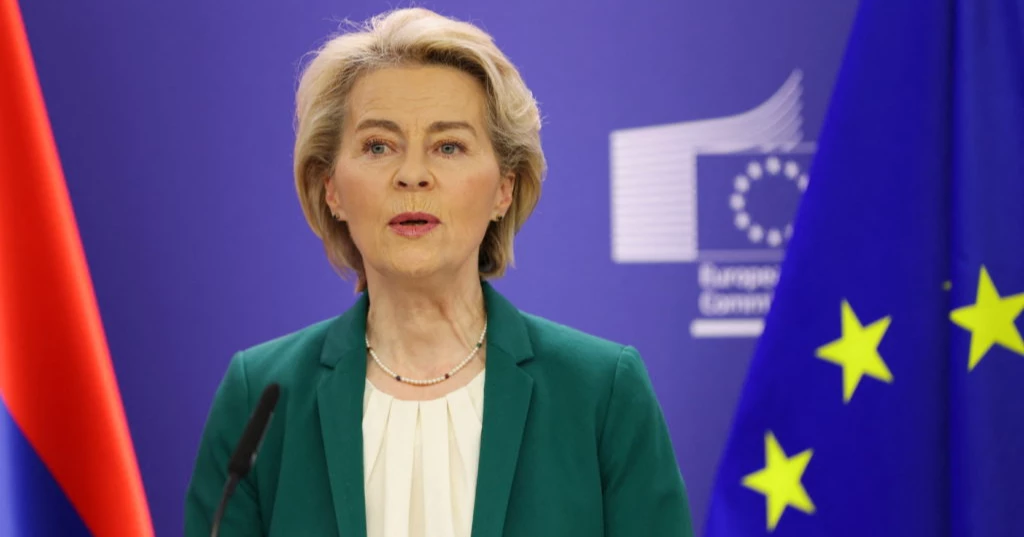
European Commission President Ursula von der Leyen will deliver a major State of the European Union address on Wednesday, outlining her priorities for the coming year and her vision for dealing with challenges facing the world's largest trading bloc.
Canadian Prime Minister Mark Carney will attend the address as a special guest at the European Parliament in Strasbourg, France.
Von der Leyen is expected to discuss artificial intelligence, climate change and the wildfires that swept across parts of Europe this summer. Other issues likely to feature include protecting children online, Russia's war in Ukraine, conflicts in the Middle East and growing tensions over international trade.
In last year's speech, she called on Europe to strengthen its independence as the United States imposed tariffs on countries and the Trump administration criticized the EU's migration policies. She warned at the time of what she called "civilizational erasure."
"Europe is in a fight," von der Leyen said. "A fight for our values and our democracies."
She also warned that new power-based divisions were emerging in the international system and said the EU must defend its position in a world where major powers are either uncertain about or openly opposed to Europe.
A political spectacle to showcase European ambition
The annual address is modeled on the State of the Union speeches delivered by US presidents to Congress. However, it is not widely broadcast, and relatively few of the EU's 450 million citizens across 27 member countries are likely to watch it.
The event is largely seen as a carefully planned communications exercise before European lawmakers, who often applaud during the speech. It is particularly followed by EU insiders.
Von der Leyen usually ends the address with her familiar rallying call: "Long Live Europe."
The speech generally focuses on broad ambitions and outlines her plans for the European Commission, the EU's increasingly influential executive body, for the coming year. Critics, however, say the commission's work can lack transparency.
Eric Maurice, an analyst at the European Policy Centre think tank, cautioned against using the speech to "placate political groups" or increase the commission president's profile and expand the commission's political and institutional influence.
"The EU is facing the crumbling of all the premises on which it was built," Maurice said, referring to the decline of a rules-based international order built around free trade and US friendship and support.
An institution with growing influence
The European Commission proposes laws that apply across the EU's 27 member countries and monitors their implementation. It also negotiates trade agreements on behalf of the bloc and serves as Europe's main antitrust authority.
Von der Leyen, 67, a former German defense minister, has emerged as a prominent figure at international summits despite being a political appointee rather than an elected EU leader.
Over her seven years in office, she has expanded her influence through major challenges, including securing COVID-19 vaccines, managing the energy crisis triggered by Russia's invasion of Ukraine and maintaining support for Ukraine during the war.
She has also earned what appears to be reluctant respect from US President Donald Trump. Von der Leyen, her chief of cabinet and trade commissioners have worked to limit the impact of Trump's tariff policies on Europe's economy.
At the same time, the Trump administration has been angered by the European Commission's actions against major technology companies, many of them based in the United States, over alleged violations of European data regulations.
Ahead of the speech, the commission launched a website dedicated to von der Leyen and the event and has distributed brochures highlighting its achievements over the past year.
The achievements include concluding new trade agreements, improving economic competitiveness, reducing energy costs, increasing defense investment, providing billions of euros in support for Ukraine and imposing sanctions on hundreds of Russian officials and organizations.