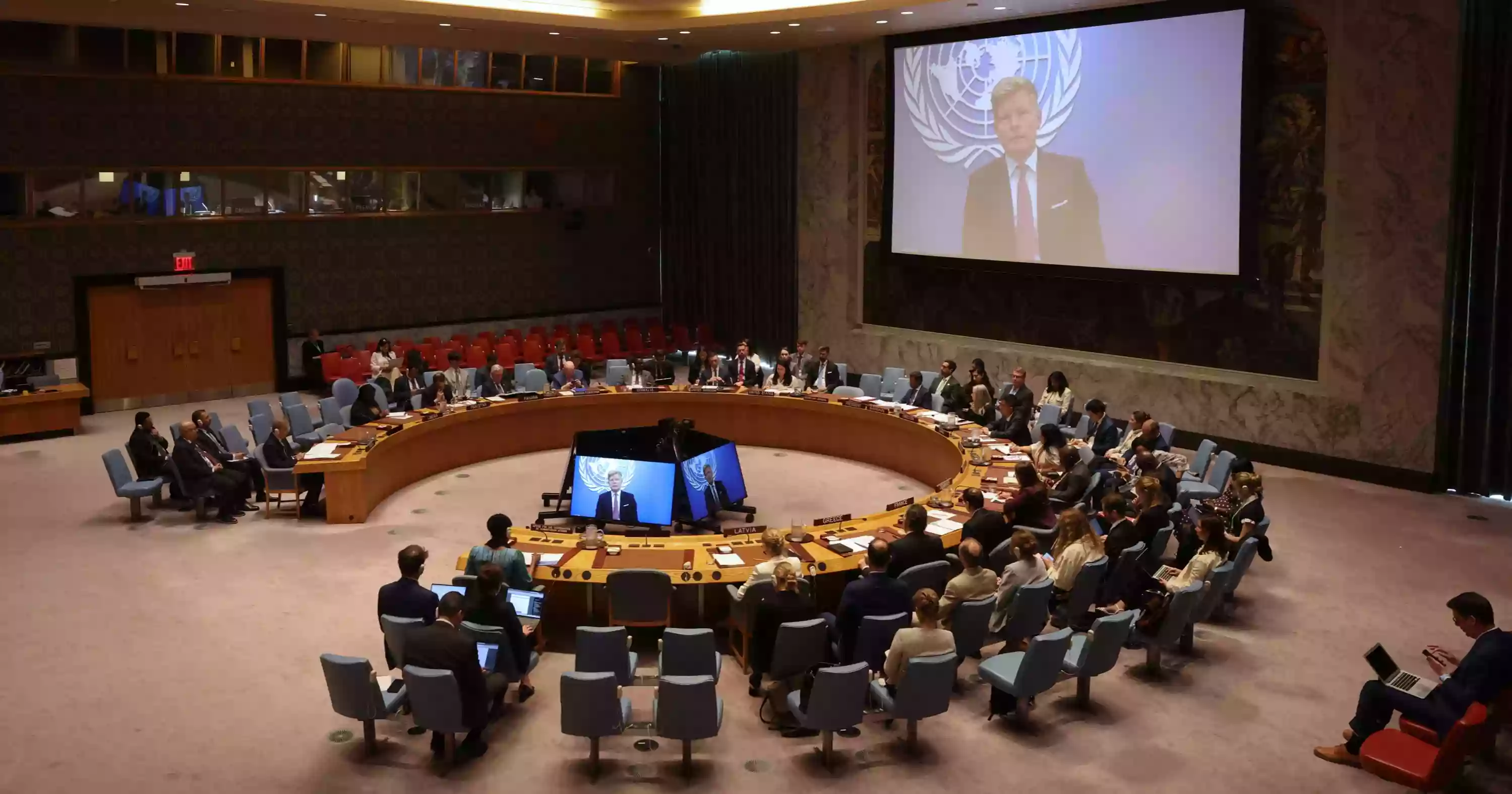
Germany suffered its first-ever defeat in a UN Security Council election on Wednesday, losing to Portugal and Austria in the race for non-permanent seats.
Why did Europe's largest economy, which had successfully secured one of the Western European seats on the Security Council every eight years for decades, lose the election this time? Here is what we know.
A QUICK DEFEAT
Without going through multiple rounds of voting like Kyrgyzstan and the Philippines, Germany, a country that has long sought a permanent seat on the Security Council, was knocked out in the first round of the race in the group of Western European and Others.
According to the election rules, candidates must secure a two-thirds majority of votes cast to win a seat. In the two-of-three competition, Portugal won 134 votes and Austria 131, both surpassing the required threshold, while Germany was eliminated with 104 votes.
In a statement on Wednesday, German Chancellor Friedrich Merz congratulated the successful competitors, emphasizing their close European partnership.
German Foreign Minister Johann Wadephul told public broadcaster ARD that the result was a "real disappointment."
LATE AND VAGUE
Wadephul mainly attributed the defeat to Germany's late entry into the race. He said Austria and Portugal received more votes primarily due to their earlier applications and the resulting commitments from other states.
However, experts have also pointed to Germany's controversial diplomatic approaches, apart from its late campaigning, as key reasons for the failure.
German magazine Der Spiegel said that many states apparently used the vote to document their displeasure with Germany's foreign policy in recent years, noting that Germany had long dodged whether the U.S. military strikes on Venezuela were a violation of international law.
That ambiguity was probably one reason many states declined to back Germany's candidacy in the vote, the report said.
Multiple German media outlets also said that Germany's close relationship with Israel may have cost it crucial votes.
German broadcaster ZDF said critics have accused the German government of applying "double standards" to international law, particularly regarding its reluctance to explicitly condemn actions by Israel in Gaza, as well as actions by the United States and Israel against Iran.
Germany's policy implementation was also questioned. "What was lacking was not ambition, but the ability to translate it into results. This runs through Germany's entire foreign and security policy," said Alexander Wolf, head of the capital office of the Hanns Seidel Foundation.
The Bundeswehr has not improved as much as promised, and strategic autonomy is discussed far more often than it is put into practice, according to Wolf.
VOICES OF SMALLER COUNTRIES
A key factor behind the success of the two European countries that outperformed Germany in the election was their commitment to multilateralism.
"As a small country, Austria has made it credible to be the voice of small countries," said Austrian Foreign Minister Beate Meinl-Reisinger when talking about the country's election victory.
As a permanently neutral country, Austria has been an advocate of multilateralism in a world marked by ongoing conflicts. Austrian President Alexander Van der Bellen said on Wednesday that Austria would steadfastly promote multilateralism in the UN Security Council based on international law and human rights.
Regarding Portugal's victory, scholars generally view the election as the result of more than a decade of sustained diplomatic efforts rather than a short-term achievement.
Daniel Cardoso, associate professor in the Department of International Relations at the Autonomous University of Lisbon, told local media that Portugal launched its campaign for a seat on the UN Security Council in 2013 and maintained the effort through successive governments of different political orientations.
Portuguese Foreign Minister Paulo Rangel said that one of Portugal's greatest strengths is its ability to "build bridges." As a member of both the EU and NATO, while maintaining close ties with the Community of Portuguese Language Countries, Africa, Latin America and Asia, Portugal is widely seen as a country capable of connecting different regions and political perspectives.