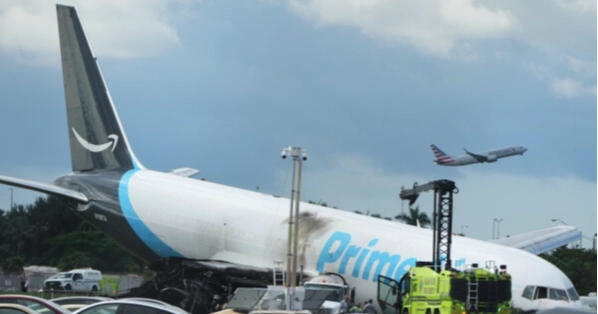
Federal investigators have begun examining the circumstances surrounding the fiery runway accident at Miami International Airport that killed five people. National Transportation Safety Board Chairwoman Jennifer Homendy said Monday that all five victims were inside a van carrying seven employees of an airport cleaning company, while an SUV outside airport property was also struck.
Homendy described the crash site from Sunday as a scene of extreme destruction. She did not say how many people were inside the SUV or specify where the five fatalities occurred.
During a tour of the crash area, Homendy followed the path taken by the Boeing 767. She pointed out tire tracks leading from the runway into the grass, the wreckage of the cleaning crew’s van, damaged fencing, airport navigation equipment and the SUV that was hit beyond airport grounds.
The debris scattered across the area included vehicle airbags and parts of the vehicles, aircraft and airport equipment. Homendy said damaged fencing could be seen throughout the site.
She described the investigation area as extensive and said the destruction must have been particularly difficult for emergency crews who responded to the accident.
The aircraft traveled approximately 1,300 feet (396 meters) beyond the paved runway before coming to a stop. Debris was spread across a large area.
The van, which contained seven people, was severely destroyed. It belonged to Professional Ocean Service Corp., a company contracted to provide cleaning services for airlines.
Homendy said the NTSB expected to release additional details Tuesday, potentially including verified information about the aircraft’s speed obtained from its flight data recorder.
Investigators focus on why the plane overran the runway
Investigators spent Monday trying to establish whether the cargo aircraft landed too far down the runway to stop safely.
Video recorded during Sunday’s landing appears to show the Boeing 767 staying in the air over a significant portion of the runway before touching down. Aviation specialists said investigators will determine the precise touchdown point, whether the aircraft landed outside the designated touchdown area and why the pilots continued the landing rather than performing a go-around.
The investigation will also consider the aircraft’s speed, braking performance, weather and wind conditions, mechanical condition and other circumstances that may have contributed to the accident.
The plane had flown from Cincinnati to Miami and continued to San Juan, Puerto Rico, before returning to Miami. At about 2 p.m. Sunday, it went beyond the runway and crossed a road serving warehouses and businesses around the airport.
Five people died, while three others suffered critical injuries and two were hospitalized with less serious injuries, authorities said.
The crash produced a large column of black smoke. Miami-Dade Fire Rescue Chief Ray Jadallah said the pilot and copilot became trapped inside the cockpit, while other people were trapped in vehicles. Firefighters also had to rescue someone who was pinned beneath a vehicle.
Aviation experts said aircraft normally touch down within the first 3,000 feet (914 meters) of a runway. If this aircraft had passed that point, safety expert Steve Arroyo said the pilots should have discontinued the landing and attempted another approach.
Mary Schiavo, a pilot and former Transportation Department inspector general, said online footage appears to show the aircraft remaining above the runway for an unusually long time without raising its nose to bring the main landing gear down.
Although there was no rain during the incident, storm clouds were visible and strong winds had been reported. Schiavo said a tailwind could have pushed the plane farther along the runway before touchdown, leaving less distance available for braking.
Miami airport lacked a runway arresting system
Miami International Airport does not have an engineered arresting system designed to stop aircraft that run beyond the end of a runway. The Federal Aviation Administration says similar systems have been installed at more than 120 airports across the United States.
These systems use lightweight, crushable materials placed at the end of runways to slow and stop aircraft. According to the FAA, they have helped save at least 497 lives in runway-overrun incidents.
Mike O’Donnell, a former FAA director responsible for airport safety and accident investigations, said Miami airport appears to meet federal requirements and was not obligated to install such a system because its runways have a 1,000-foot safety area beyond their ends.
The safety requirements were strengthened after American Airlines Flight 1420 overran a runway at Little Rock National Airport in Arkansas in 1999, killing nine people.
Images from Sunday showed the Prime Air aircraft stopped near a roadway and two tractor-trailers. The plane appeared to have come to rest on its underside and remained largely intact despite the fire.
The flight was operated by 21 Air, a North Carolina-based cargo airline. The Boeing 767 was about 32 years old. It was initially manufactured as a passenger aircraft and operated by several airlines for more than 20 years before being converted into a freighter in 2015, according to Flightradar24.
Schiavo said investigators are also expected to closely review the aircraft’s maintenance records, particularly because the plane previously had foreign owners, including a Russian company.
Crash disrupts flights at Miami airport
The accident caused widespread disruption at Miami International Airport, with flights suspended for much of Sunday afternoon and delays continuing into Monday.
Airport officials said two of the facility’s four runways remained closed Monday. Operations were expected to remain disrupted because aircraft and flight crews that had been scheduled to arrive were displaced by cancellations following the crash.
The airport reported 160 canceled flights and more than 300 delays Sunday. By mid-afternoon Monday, another 69 flights had been canceled, while flight-tracking services showed significant delays across the airport.
Amazon said it would cooperate fully with the investigation and expressed sympathy for those affected by the tragedy.
The company said it was deeply saddened by the deaths and offered condolences to the victims’ families, friends and everyone affected by the accident.
The Miami crash follows another deadly U.S. cargo-plane accident last year. A UPS aircraft crashed at Louisville Muhammad Ali International Airport after losing an engine while accelerating for takeoff. All three pilots and 12 people on the ground were killed, while another 23 people were injured.