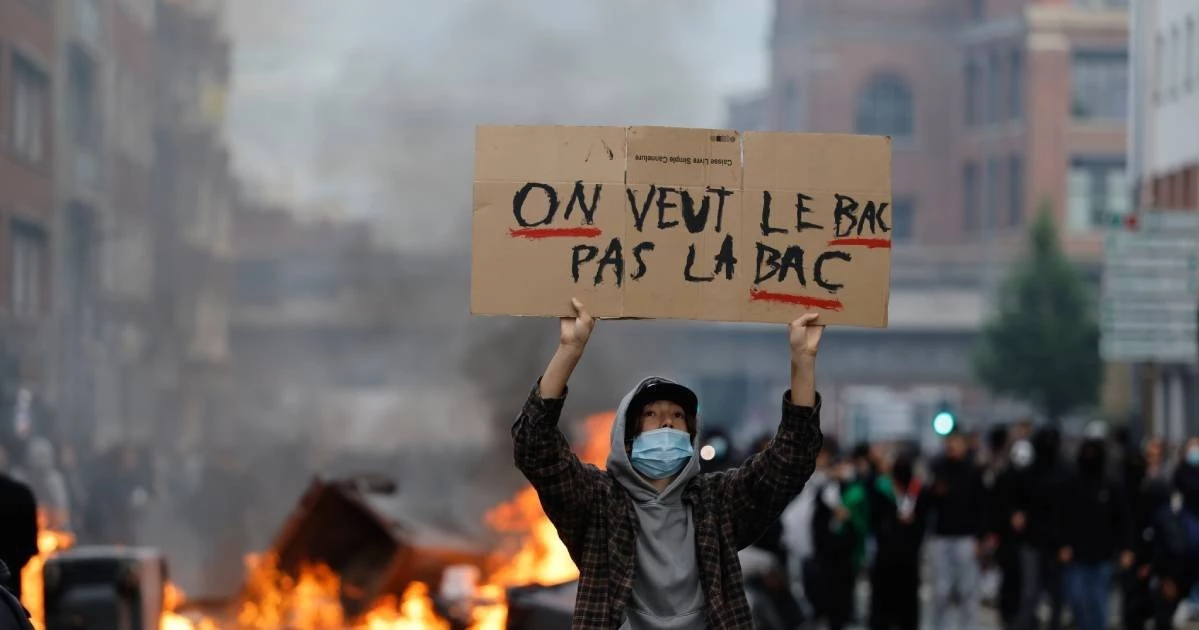
France’s prime minister called an emergency meeting Thursday and asked ministers to cancel planned trips as student protests spread across the country, with high school students demonstrating over underfunded schools, long school days and other grievances.
The protests began at schools in the Paris region last week and have since expanded, with police making hundreds of arrests during clashes with demonstrators. Authorities have reported dozens of injuries, including those caused by objects thrown during protests and, in some suspected cases, by police riot-control projectiles.
The demonstrations are emerging as a major issue in the campaign for next May’s presidential election. President Emmanuel Macron cannot seek a third consecutive term under France’s Constitution. The unrest is also adding pressure on a government struggling with the country’s worsening finances and has overshadowed Thursday’s release of a proposed cost-cutting budget for 2027.
At a Paris high school where students blocked an entrance, 18-year-old Salama Gargouri said protesters were demanding changes to “overloaded schedules, the system, the teachers, people who don't listen to us, the university application process.”
French high school students often begin classes at 8 a.m. and remain at school until late afternoon.
“Older people say, ‘Kids, go to school from 8 a.m. to 6 p.m. every day.’ But you don't know what that does mentally,” said Janna Tahari, another Paris high school student.
Some demonstrations have been marred by arson, thrown objects and other violence, leading to increasing injuries and accusations between protesters and authorities. Interior Minister Laurent Nuñez has ordered police to clear blockades that prevent students from attending classes and to stop violence and vandalism.
Juliette Estiville, a high school Spanish teacher, said the government’s response to the protests prompted her to join the students.
“So, I'm here just to provide protection, to form a barrier between the police and the students,” she said. “And indeed, today went well, it's going well, but I really think that the teachers who come to the blockades are really just there to protect our young people.”
Education Minister Edouard Geffray said Thursday’s violence included a school being set on fire and staff members being doused with gasoline. He said he had instructed schools to conduct classes remotely when blockades or damage made it unsafe for students to attend.
“Violence will not deprive our students of their fundamental right to education,” Geffray said in a post on X.
Far-left presidential candidate Jean-Luc Mélenchon has criticized the government’s response as repressive. Critics of Mélenchon have accused his party of encouraging violence and exploiting the unrest ahead of the presidential election.
The office of Prime Minister Sébastien Lecornu said he had asked ministers to cancel planned official trips in the coming days so authorities and police could concentrate on managing the demonstrations.