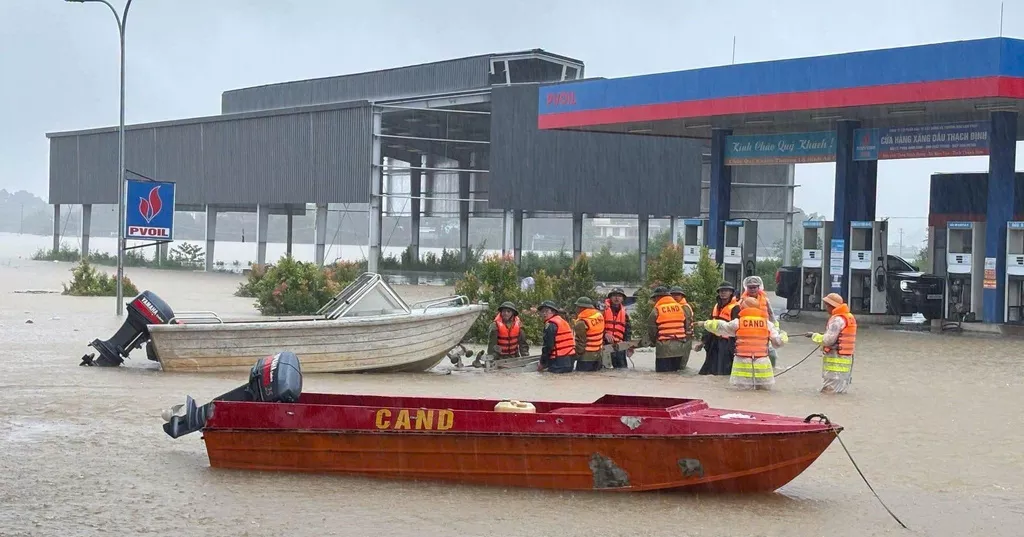
Heavy rainfall triggered flooding across parts of northern Vietnam on Thursday, disrupting transportation, inundating homes and pushing several rivers to dangerous levels, authorities and state media reported.
Northern and north-central Vietnam have experienced heavy rain throughout the week, with some areas recording more than 50 centimeters (19.7 inches) of rainfall, according to the disaster prevention department.
More than 2,000 homes have been inundated, while many major transportation routes have been blocked and more than 1,000 households remain isolated. Ninh Binh and Thanh Hoa provinces, which cover lowland and hilly areas south of Hanoi, have been among the worst affected.
Vietnam is one of the world’s most climate-vulnerable countries and is frequently affected by flooding. A series of severe storms last year prompted the country to seek new ways to prepare for and manage floods.
In Thanh Hoa province, authorities advised students to stay home as flooding made travel to schools unsafe, state media reported.
Heavy rain and flooding have submerged or damaged about 10,014 hectares (24,745 acres) of rice and other crops, with the biggest losses reported in Ninh Binh, Thanh Hoa and Nghe An provinces. Thousands of livestock and poultry have also died.
“The flood happens every year,” Ninh Binh resident Tran Ngoc Tai told national broadcaster VTV, saying that residents had prepared supplies of fresh water and food.
Several streets in Hanoi were heavily flooded Thursday morning, with water reaching nearly a meter (3.2 feet) in some areas. The flooding disrupted traffic and made it difficult for residents to travel to work, take children to school or leave their homes.
State media reported that rainfall between Wednesday night and Thursday morning exceeded 15 centimeters (5.9 inches) in some areas.
Many high schools and universities in Hanoi remained closed or shifted to online classes Thursday afternoon as heavy rain caused widespread flooding.
Rising water levels in the Bui River on the southwestern outskirts of Hanoi threatened nearby homes, prompting authorities to deploy hundreds of soldiers to help residents move their belongings to higher ground, state media reported.
A cold air mass moving south is expected to bring five days of heavy rain to southern Vietnam, including flood-prone Ho Chi Minh City, the country’s financial hub, from Sept. 17, according to the Southern Regional Hydro-Meteorological Center.
Forecasters expect widespread rainfall through Sept. 21, while authorities have warned of flooding in low-lying areas and along waterways. Ho Chi Minh City is forecast to receive 10 to 20 centimeters (4 to 8 inches) of rain, with some areas expected to receive higher amounts.
Vietnam experienced repeated severe flooding in 2025. Tropical Storm Wipha brought heavy rain and flooding in July, followed by further flooding and landslides in August when Tropical Storm Kajiki struck. Typhoon Bualoi killed at least 26 people in September.
In October, the historic central Vietnamese cities of Hue and Hoi An were flooded, along with large parts of northern Vietnam.