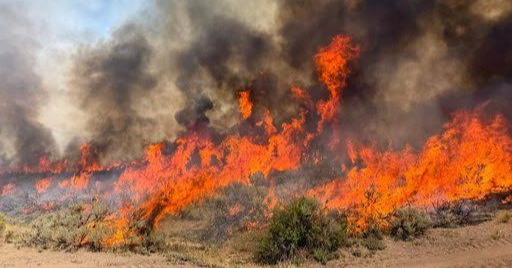
A heavy-lift helicopter carrying two people crashed Friday while assisting firefighters battling a large wildfire in central Utah. The incident occurred as crews in Oregon continued efforts to contain another uncontrolled fire that killed a bulldozer operator.
Authorities had not yet confirmed the condition of the two people aboard the helicopter because emergency teams were unable to reach the crash site immediately.
In Oregon, 47-year-old Jason Ensign died Thursday while operating a bulldozer for a timber company. Officials said the Wrights Spring Fire grew rapidly and unexpectedly, blocking his escape route, according to the local sheriff's department.
The Oregon fire began Wednesday in the south-central part of the state, east of Chiloquin. By Friday, it had spread across nearly 14 square miles (36 square kilometers) and remained completely uncontained, the U.S. Forest Service reported. Officials attributed the unpredictable fire behavior to extremely hot and dry conditions.
The helicopter involved in the Utah crash was among seven aircraft assisting with a wildfire in central Utah that was sparked by lightning on July 27. The aircraft went down near Richfield, roughly 160 miles (258 kilometers) south of Salt Lake City, the Federal Aviation Administration said.
Tyler Hecht of the Great Basin Incident Management Team said weather conditions were considered suitable for aerial firefighting at the time of the crash.
The aircraft, a Sikorsky S-64, had been operating over rugged, steep terrain. The crash also sparked an additional fire. Hecht said during an afternoon news conference that officials did not know how long the helicopter had been airborne before the accident.
Fire and rescue crews were unable to reach the crash site by Friday evening because of the surrounding flames. Officials hoped to gain access within the following 24 hours.
“We didn't want to put them at bigger risk,” Sevier County Sheriff Nathan Curtis said, adding that crews would enter the area as soon as conditions allowed.
Officials also said they could not determine whether the wildfire had reached the crash site.
Aerial firefighting operations were temporarily suspended following the accident but were later restarted.
The National Transportation Safety Board and the FAA are expected to investigate the crash. However, investigators could face delays in reaching the site if the wildfire continues to burn in the area.
Sikorsky S-64 “Skycrane” helicopters are operated by government agencies and private companies for firefighting and other heavy-lifting tasks. The aircraft can carry tanks containing water or fire retardant, which can then be released over active fires.
Firefighters had been warned Friday morning to prepare for unpredictable winds, extremely dry vegetation and high temperatures. Forecasters also warned of possible dry thunderstorms and lightning, while red flag warnings remained in effect.
The Utah wildfire, burning in the Fishlake National Forest near the small community of Kanosh, had expanded to approximately 165 square miles (427 square kilometers) by Friday morning. It was about 19% contained. More than 600 firefighters were working to control the blaze, which has forced evacuations and destroyed at least six structures while spreading through forests, brush and grassland.
Prolonged dry conditions, unusually low snowfall in some areas, periods of extreme heat and unpredictable winds have contributed to an increase in wildfires across Utah and other parts of the western United States.
In Colorado, four firefighters died and another was injured in June after being trapped by a rapidly advancing wildfire. The crew attempted to protect themselves by deploying emergency fire shelters as flames swept over their location.