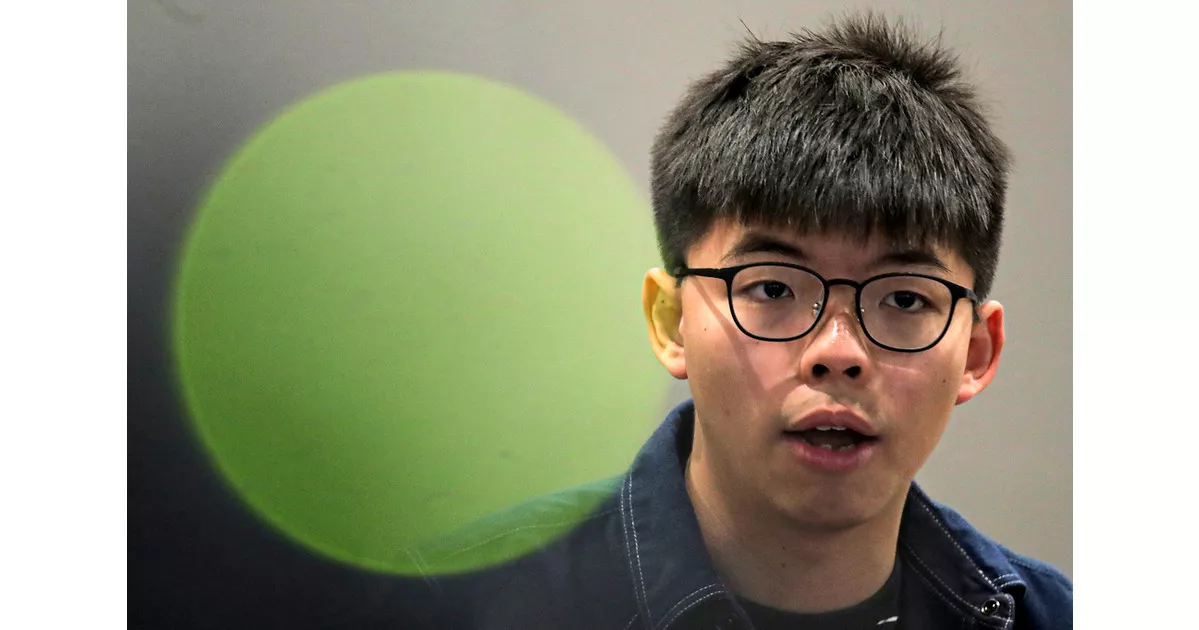
Prominent pro-democracy activist Joshua Wong was sentenced to another 10 years in prison on Thursday under a Beijing-imposed national security law, in a case that critics say reflects the continuing crackdown on Hong Kong’s democracy movement.
Wong, 30, was already serving a four-year and eight-month prison term after pleading guilty in a major national security case. He had been scheduled for release in January but faced fresh charges in 2025 over alleged conspiracy to collude with foreign forces to endanger national security.
High Court Judge William Tam said Wong and fellow activist Nathan Law had worked with foreign officials and other actors to seek measures against China and Hong Kong.
The judge cited US actions, including the withdrawal of Hong Kong’s preferential trade treatment and sanctions against Chinese and Hong Kong officials, as examples of the measures the activists had sought.
“The punishment must fit the gravity of the crime committed,” Tam wrote, adding that the court needed to reflect public condemnation of the offence.
Wong pleaded guilty to the latest charge earlier this year. The judge said he had considered a 13-year sentence as a starting point but reduced it in view of the guilty plea and other mitigating factors. The remaining two months of Wong’s previous sentence will run concurrently with the new term.
The United States strongly condemned the ruling and called for Wong’s immediate release. Its consulate in Hong Kong said he had been “unjustly imprisoned” since late 2020, accusing Beijing of seeking to silence advocates of fundamental freedoms.
Wong appeared calm during Thursday’s hearing, nodding to supporters in the courtroom before the sentence was announced. He thanked them in Cantonese as he left.
In a statement written from prison, Wong said he had believed his actions were lawful and that he had not directly advocated sanctions when sharing others’ social media posts or urging foreign companies to reconsider business with Hong Kong police. He said he later realised his judgment had been wrong.
He added that he had taken university courses and read extensively during nearly six years in prison, seeking to improve himself.
Wong first rose to prominence as a teenage student activist and became a leading figure in Hong Kong’s pro-democracy movement. His latest sentence has renewed concerns among observers that national security charges could be used to keep prominent activists behind bars.
Eric Lai, a research fellow at Georgetown Center for Asian Law, said the law could be repeatedly used to prolong the imprisonment of specific political prisoners.
Hong Kong witnessed massive anti-government protests in 2019. Since then, authorities have arrested leading activists, reduced public participation in elections, and seen several critical media outlets and civil society groups shut down.
Beijing considers Wong an anti-China figure, while Hong Kong authorities maintain that the national security law is necessary to ensure stability following the 2019 unrest.
Chinese Foreign Ministry spokesperson Guo Jiakun said Wong had pleaded guilty in the face of strong evidence and that Beijing supported Hong Kong in safeguarding national security.
Hong Kong Chief Executive John Lee described Wong, Law and their associates as key figures responsible for undermining the city’s prosperity and stability. Police also welcomed the ruling.
However, the UK Foreign, Commonwealth and Development Office said the sentence illustrated how the security law was being used against people for political expression and participation.
Wong’s supporters regard him as a prominent voice of a younger generation that grew up before Hong Kong’s return to Chinese rule in 1997.