
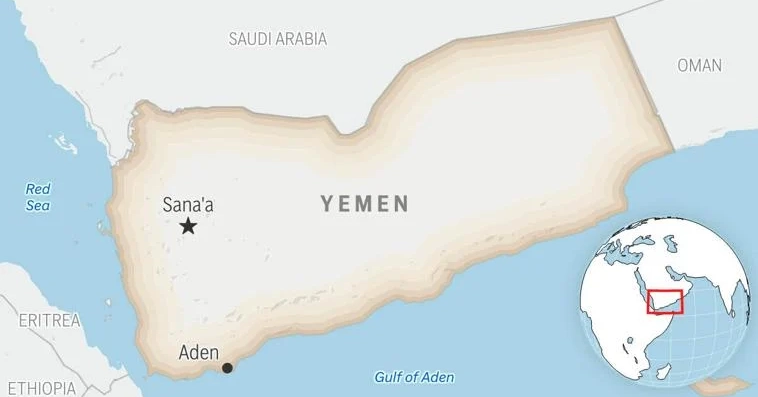
Yemen's Iran-backed Houthi rebels on Monday announced a maritime embargo on Saudi Arabia, saying they will block Saudi shipping through the Bab al-Mandeb Strait in response to what they described as the Saudi-led blockade on Yemen and a recent strike on Sanaa International Airport.
Houthi military spokesperson Yahya Saree said in a video statement that the embargo would take effect immediately, calling it an "eye for an eye" response.
The group did not provide details on how the embargo would be enforced. However, Nasruddin Amer, deputy head of the Houthi media office, wrote on X that the Bab al-Mandeb Strait would be closed to Saudi shipping in retaliation for what he called Saudi Arabia's "unjust blockade on Yemenis for over 10 years."
Located at the southern entrance to the Red Sea, the Bab al-Mandeb Strait is one of the world's busiest maritime routes. About 12% of global trade passes through the waterway, while roughly one-quarter of global container traffic travels through the 32-kilometre (20-mile) strait to and from the Suez Canal.
The Houthis previously demonstrated their ability to disrupt shipping in the area by attacking more than 100 vessels during the Israel-Hamas war in Gaza. It remains unclear whether they intend to resume attacks on that scale against Saudi-linked shipping.
Saudi Arabia did not immediately comment on the announcement. The kingdom has already been relying heavily on its East-West Pipeline to transport crude oil to the Red Sea as an alternative to the Strait of Hormuz, where Iran tightened control following U.S. and Israeli strikes on Feb. 28. Millions of barrels of Saudi crude are transported daily through the pipeline.
Saudi Arabia has led a military coalition against the Houthis since 2015 and imposed an air and sea blockade on Yemen after the rebels seized the capital, Sanaa, and much of northern Yemen in 2014, forcing the internationally recognised government into exile. Although a UN-brokered truce was reached in 2022, tensions have risen again in recent days.
The Houthis recently accused Saudi Arabia of targeting Sanaa International Airport in an attempt to stop a flight carrying senior Houthi officials returning from Iran, where they had attended the funeral of Supreme Leader Ayatollah Ali Khamenei. The aircraft landed safely at another airport.
In response, the Houthis launched missiles and drones at Saudi Arabia's Abha International Airport, marking the most serious escalation between the two sides in years.
According to analysts quoted by AP, the Houthis sought to establish greater control over Yemen's airspace by allowing an international flight to land without approval from the Saudi-led coalition.
"We affirm the right of our great people to respond to the blockade with a blockade," Saree said, warning that the group was ready to respond to any further Saudi action with what he described as a "comprehensive and decisive escalation."
The Houthis are a key member of Iran's so-called "Axis of Resistance," an alliance that also includes armed groups in Lebanon, Iraq and the Palestinian territories.
Although the rebels have built up a large arsenal of drones, several Houthi members previously told AP that supplies had been depleted following prolonged attacks during the Israel-Hamas war. They also said the recent conflict involving Iran has further disrupted the flow of weapons.
Earlier Houthi attacks on commercial shipping prompted a sustained U.S. and Israeli air campaign targeting Houthi-controlled areas in Yemen until an agreement was reached that led the group to halt those assaults.
Any major disruption to shipping through the Bab al-Mandeb Strait would force vessels to take the much longer route around the Cape of Good Hope, significantly increasing shipping time and costs.