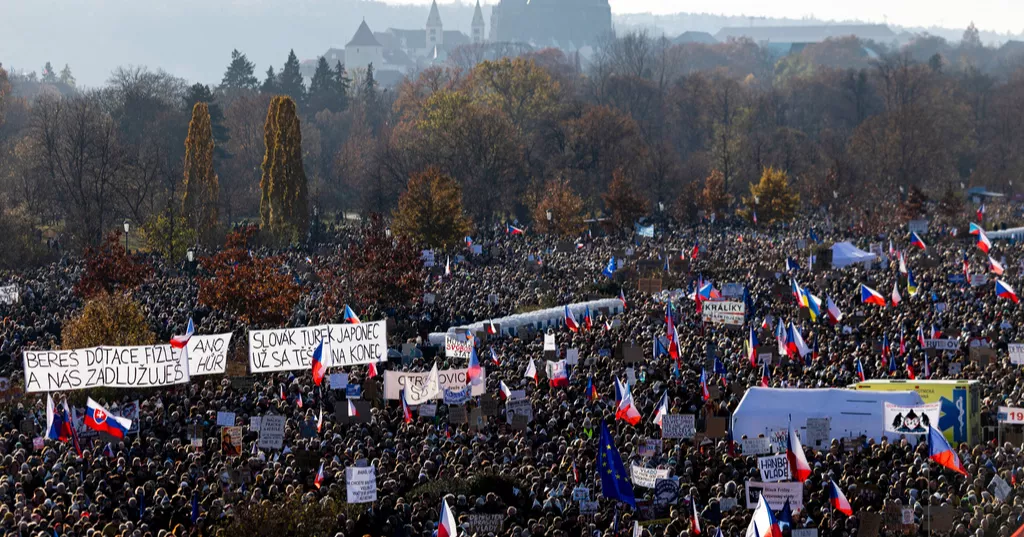
Hundreds of thousands of people gathered in Prague on Sunday to protest the Czech government's plan to overhaul the funding system for public broadcasters, warning that the move could undermine media independence and democracy.
The massive rally took place at Letná Park, a historic site where large crowds assembled during the 1989 Velvet Revolution that ended more than four decades of communist rule in the country.
The demonstration, held two days before the anniversary of the 1989 protests, drew an estimated 350,000 people, according to Mikuláš Minář, the lead organiser of the Million Moments for Democracy group.
The protesters demanded that the government abandon the plan and voiced concerns over the policies of billionaire Prime Minister Andrej Babiš and his coalition partners.
"We do witness here something extraordinary today," Minář said, adding, "It's just a beginning."
Under the proposed changes, public radio and television broadcasters would receive funding from the state budget instead of the existing system of regular fees paid by individuals, households and businesses.
The broadcasters would receive around 15 percent less funding than they currently do, potentially leading to job cuts, reduced production and programme cancellations.
Critics argue that the proposed changes would allow the three-party coalition government to exert control over public media, drawing comparisons with developments under populist governments in Slovakia led by Prime Minister Robert Fico and in Hungary before former Prime Minister Viktor Orbán was removed from power in April.
"We refuse the Slovak scenario," read one protest banner, while another declared, "Hands off the media."
Singer Šarka Dumišincová, who joined the demonstration, said the media represented freedom and that attempts to control that freedom were unacceptable.
Government accused of rushing legislation through parliament
The ruling coalition unexpectedly advanced the proposed changes in the lower house of parliament on October 24.
Before voting at 4:36am to pass the bill through its first of three parliamentary readings, government lawmakers restricted the time available for opposition members to speak.
Thousands of people took to the streets the following day to protest the process, while employees of public media organisations staged a strike on November 3.
The strike received support from labour unions, universities, students, churches, artists, athletes and international media organisations, among others.
"We are here to stand up against the rule by force in the style of 4:36," Minář said at Sunday's rally, referring to the time the bill passed its first reading.
Media freedom and the rule of law in the Czech Republic were also discussed at the European Parliament on Wednesday.
EU Justice Commissioner Michael McGrath said national legislation must ensure that public service media funding is based on transparent and objective criteria and provides "adequate, sustainable and predictable financial resources."
Babiš rejects criticism, vows to proceed with plan
Despite the protests, Babiš has pledged to move forward with the proposed changes, denying that they would affect media freedom.
He returned to power after his ANO, or YES, movement won last year's election and formed a coalition with two smaller political groups — the anti-immigration and pro-Russian Freedom and Direct Democracy party, and the right-wing Motorists for Themselves.
Babiš has opposed several key European Union policies on the environment and migration, rejected financial assistance for Ukraine and opposed guarantees for EU loans intended to help the country defend itself against Russia's invasion.
His government has also faced criticism from NATO allies over its failure to spend enough on defence.
Sunday's protesters also criticised the government's defence policy and called for the resignation of Freedom and Direct Democracy leader and parliamentary Speaker Tomio Okamura, as well as Defence Minister Jaromír Zůna. The party controls the defence ministry.
"While (Russia's President Vladimir) Putin threatens Europe, the pro-Russian (party) is systematically undermining the state's defensive capability and endangering national security," Minář said.