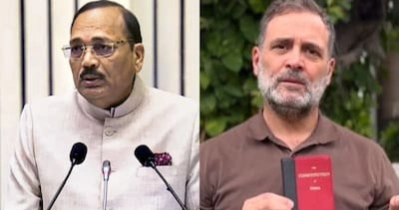
India's Chief Justice Surya Kant has declined a meeting request from opposition INDIA bloc leaders over alleged electoral irregularities, saying the Supreme Court's doors are open to everyone but the matter should be raised through a formal petition as it is already before the court.
The opposition parties announced plans to march to the Supreme Court on Monday as part of their campaign against Chief Election Commissioner Gyanesh Kumar, accusing the election authorities of “vote chori”, or stealing votes.
Congress leaders Rahul Gandhi and Mallikarjun Kharge had written to the Chief Justice, seeking a meeting between 4pm and 5pm to submit a memorandum demanding an end to alleged electoral manipulation, Kumar's resignation, suspension of the Special Intensive Revision (SIR) of electoral rolls and a return to paper ballots.
“I received a letter yesterday regarding a meeting request, and I responded to it last night, outlining the reasons why I will be unable to meet,” Chief Justice Surya Kant told reporters after an event marking the National Human Rights Commission's 33rd Foundation Day on Monday.
“The Supreme Court's doors are open to everyone. Any petition from any common citizen or member of an elected body is welcome. Every Indian citizen has the right to approach the court, and we will hear their concerns and grant whatever is due under the law,” he said.
According to sources, the Chief Justice's response said the concerns raised by Gandhi, the Leader of the Opposition in the Lok Sabha, and other opposition leaders would be better addressed through judicial proceedings rather than by submitting a memorandum through administrative channels.
The Congress has called Monday's protest “Chalo Delhi — March for Democracy”. Participants were scheduled to gather at the Connaught Place-Barakhamba Road junction at 1:30pm before marching towards the Supreme Court.
In a post on X, Gandhi said the march would bring together Indians across political parties, genders, castes, communities and states.
“Yesterday, the nation's youth came out in Delhi to peacefully protest. They came with love in their hearts, not hatred or anger. They were beaten, both by cops and BJP goons. This is not the India we want,” Gandhi wrote.
“Tomorrow, we will march to the Supreme Court as Indians, united beyond party, gender, caste, community and state. Youth, all opposition parties, civil society groups, and all those who believe in democracy and stand by the Constitution of India will walk with us,” he added.
On Friday, leaders of several INDIA bloc parties marched from Parliament to Vijay Chowk and later submitted a memorandum to President Droupadi Murmu.
Speaking in Bengaluru on Sunday, Kharge accused Prime Minister Narendra Modi and Home Minister Amit Shah of creating chaos across the country. He said the heavy police deployment and detentions during Saturday's protests reflected the government's fear of the youth-led agitation.
“Yesterday, nearly 32,000 police personnel and 7,500 CRPF personnel were deployed. This itself shows how much the government fears the youth agitation,” Kharge said.
He alleged that the government's actions showed it did not want democracy to function peacefully in India.
“We will continue our fight to protect democracy and the constitutional rights of the people,” he added.
Gandhi and Kharge had also written to the Chief Justice in June on behalf of the INDIA bloc. The letter was signed by the DMK and the Aam Aadmi Party as well.
The opposition described the SIR exercise as a “monumental disaster” and raised concerns about the conduct of Chief Election Commissioner Gyanesh Kumar.
In their June letter, the leaders said they believed the electoral process was being manipulated and that results in several instances did not reflect the people's wishes.
They accused the Election Commission of India, particularly the Chief Election Commissioner, of bias and alleged that its actions had favoured the BJP during elections and influenced their outcomes.
The letter also criticised the voter grievance mechanism as inadequate and alleged that large numbers of names had been removed from electoral rolls arbitrarily without proper notice.
Although the stated purpose of the SIR exercise was to remove duplicate entries and the names of deceased and migrant voters, the opposition argued that its implementation lacked transparency and differed from previous procedures.
The opposition's campaign has intensified following a report by The Indian Express claiming that Election Commissioners Sukhbir Singh Sandhu and Vivek Joshi had recorded objections at least 14 times over the previous 10 months, including over the SIR exercise.
Last week, the INDIA bloc finalised a joint action plan over the voter-list revision controversy, including rallies and marches under the banner of “Save Democracy”.
Source: NDTV