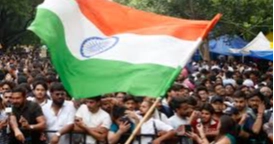
Supporters of India’s youth-driven Cockroach movement on Tuesday vowed to continue their protest in New Delhi, a day after police used tear gas and batons to disperse thousands of demonstrators attempting to march towards Parliament.
Hundreds of protesters remained at Jantar Mantar, the capital’s designated protest venue, amid a heavy police presence, saying they would continue their sit-in until Education Minister Dharmendra Pradhan resigns over alleged shortcomings in the country’s examination system.
“We will continue our protest,” said Abhijeet Dipke, founder of the Cockroach Janta Party (CJP).
The clash between protesters and police on Monday marked a major turning point in the CJP’s two-month campaign. What began as a satirical protest has grown into a nationwide youth movement demanding action on issues including exam leaks, unemployment and government accountability.
Videos showing police using batons against protesters and removing demonstrators by force spread widely on social media, triggering public anger. Some footage showed young protesters crying and appealing to police not to attack them, while other scenes showed demonstrators standing firm despite baton charges.
Delhi Police said around 180 people were injured during the confrontation, including 118 security personnel and 60 protesters.
Sona Bisht, a 20-year-old student who joined the protest, said the police action had only strengthened her determination.
“If the government thinks they can stop Gen Z by doing this, they are mistaken. We are here raising issues about education and our future. We will not leave until our demands are fulfilled,” she said.
The government made its first apparent attempt to engage with the protesters after nearly a month of silence, with a senior minister holding discussions with movement representatives on Monday. However, the talks failed to calm tensions as protest leaders said they wanted concrete action rather than assurances.
Their demands include the resignation of Pradhan, reforms in the examination system and compensation for families of students who died by suicide following alleged irregularities in recruitment and entrance examinations.
Dipke accused the authorities of going back on their commitment, alleging that police launched a baton charge after inviting protesters for talks.
Rights organisation Amnesty International criticised the police response, saying the action demonstrated how peaceful dissent was being restricted in India.
“The role of authorities is to protect and facilitate peaceful protests, not suppress them,” the organisation said, adding that the right to peaceful assembly is protected under international human rights law and the Indian Constitution.
The movement, which has attracted students, professionals and families, represents a significant challenge to Prime Minister Narendra Modi’s government during its third term. It has revived debate over the government’s handling of public dissent and the use of force against demonstrators.
The campaign gained further momentum after prominent activist Sonam Wangchuk, whose three-week hunger strike became a symbol of the protests, was taken to a hospital by police over the weekend.
Rabina Kashyap, a 26-year-old professional, said she joined the protest on Tuesday after watching footage of police using tear gas and batons against students.
“I have nothing to do with this protest. But this is India, my country, and these are my people. So I will stand with them,” she said.