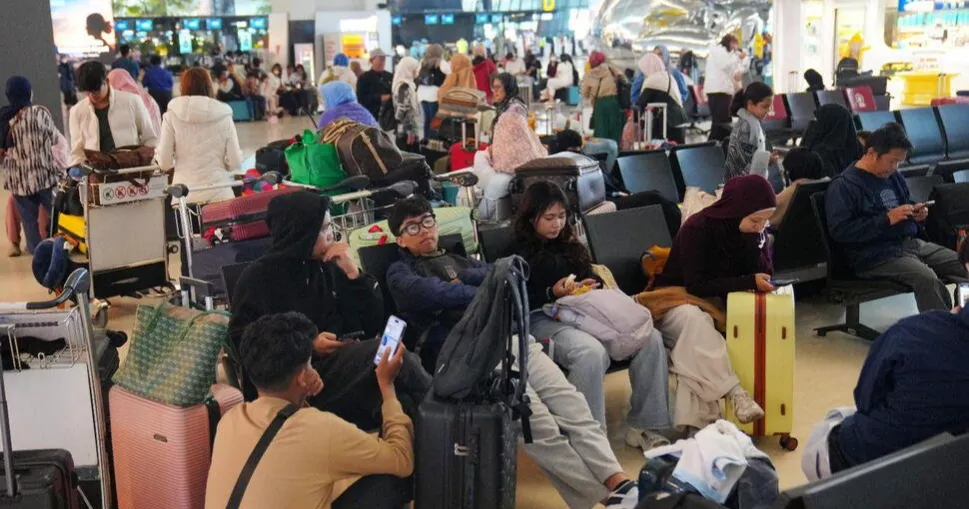
Indonesia kept several airports closed and allowed schools in affected areas to shift to online classes Monday, as volcanic activity from Anak Krakatau eased after an eruption that disrupted around 2,300 flights and spread ash across several areas.
The eruption lasted about 25 hours and ended Sunday, producing a lava fountain and a powerful boom that could be heard as far as 700 kilometers (435 miles) away, according to the country’s Geological Agency.
However, the volcano remained active Monday, with moderate and intermittent eruptions, dark ash clouds and small local earthquakes, the agency said. Poor weather conditions were also making it difficult to observe the volcano clearly.
AirNav Indonesia said tests detected volcanic ash in the airspace over Jakarta and several other cities. As a precaution, authorities closed eight airports until 6 p.m. Monday.
The closures included four commercial airports operated by state-owned InJourney Airports — Jakarta’s Soekarno-Hatta and Halim Perdanakusuma international airports, Husein Sastranegara in West Java and Radin Inten in Lampung, on the southern tip of Sumatra.
InJourney Airports said the closures had disrupted about 2,300 flights and affected 268,539 passengers at its four airports.
The eruption also affected education. The government allowed schools in ash-affected areas, including parts of Jakarta, West Java, Banten and Lampung provinces, to temporarily conduct classes online from students’ homes to limit their exposure to volcanic ash.
Lana Saria, head of the Geology Agency, warned that the risk of further eruptions remained high in the coming days.
She said potential dangers included volcanic rocks, heavy ashfall and lava flows if the eruption continued for a prolonged period.
Anak Krakatau is a volcanic island in the Sunda Strait, located between Indonesia’s main islands of Java and Sumatra. Its name means “child of Krakatau” because it emerged from the remnants of the notorious Krakatau volcano.
Krakatau’s massive 1883 eruption triggered a period of global cooling and remains one of the most powerful volcanic eruptions in recorded history.
In 2018, Anak Krakatau erupted and triggered a tsunami that killed at least 430 people on the coasts of Sumatra and Java. Researchers believe the eruption caused an underwater landslide, sending a large section of the volcano’s southwestern slope into the sea and displacing a huge volume of water.
Indonesia has more than 120 active volcanoes and regularly experiences eruptions because it lies along the Pacific “Ring of Fire,” a zone of seismic faults surrounding the Pacific Ocean where much of the world’s earthquake and volcanic activity occurs.