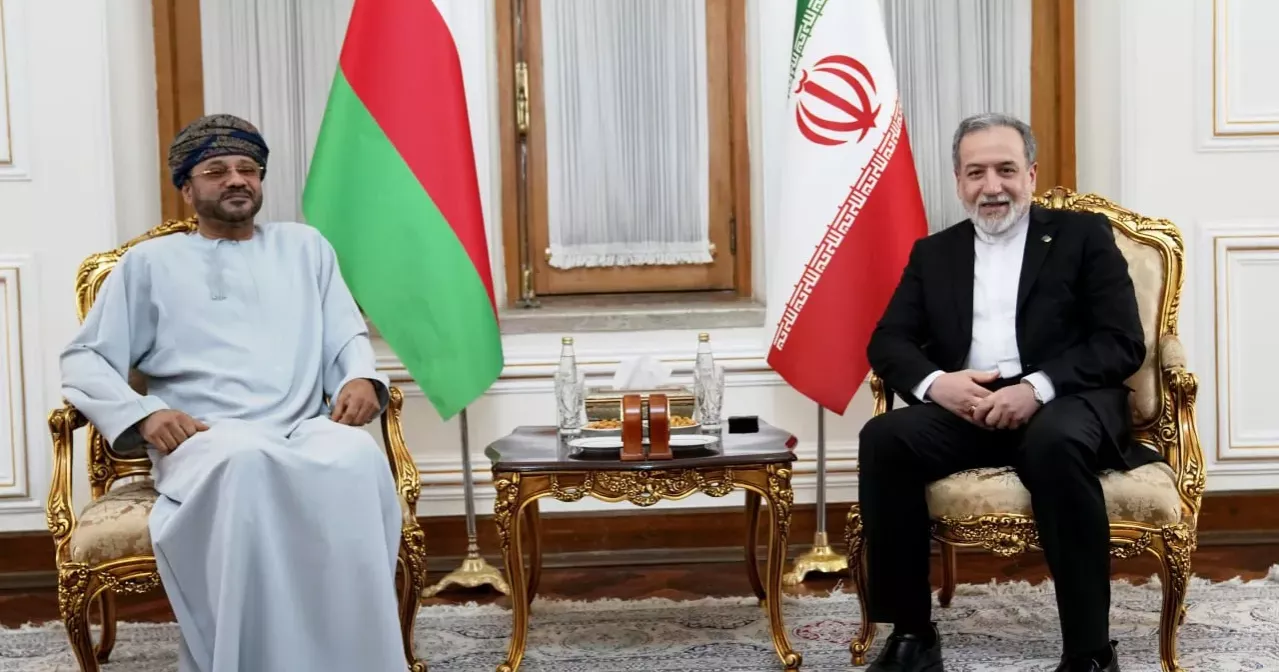
Iran and Oman held high-level talks on Tuesday on a phased plan to manage shipping through the Strait of Hormuz, where maritime traffic remains severely restricted nearly six months after the start of the Iran war.
The discussions followed an attack that disabled an oil tanker off Oman's coast, highlighting the continuing risks faced by commercial vessels attempting to navigate the strategically important waterway under Iranian control.
Here are the latest developments from the Iran war and the broader Middle East:
Iran and Oman agree to work on temporary shipping route
Omani Foreign Minister Badr al-Busaidi met Iranian Foreign Minister Abbas Araghchi in Tehran to discuss arrangements for managing maritime traffic through the Strait of Hormuz.
In a joint statement, the two countries said they had proposed establishing a “joint temporary navigational corridor” and cooperating on efforts to remove mines from the waterway.
The two sides also agreed to continue technical discussions aimed at creating a permanent shipping corridor and determining how the strait would be managed in the future.
Iranian Deputy Foreign Minister Kazem Gharibabadi told state television that Tehran and Muscat had reached an understanding on a temporary route. Under the proposed arrangement, vessels entering the Persian Gulf from the Gulf of Oman would travel entirely through Iranian waters, while ships heading out would use both Iranian and Omani territorial waters.
The two countries are expected to negotiate for 30 to 60 days in an effort to establish a permanent and sustainable route, Gharibabadi said.
Before the United States and Israel launched attacks on Iran on Feb. 28, roughly one-fifth of global oil shipments passed through the Strait of Hormuz.
It remains unclear whether Washington will support the proposed arrangement. US President Donald Trump last week threatened military action against Oman if he believed the country was obstructing American efforts to reopen the strait.
Iranian President Masoud Pezeshkian and other senior officials also discussed the waterway with a Pakistani delegation that left Tehran on Tuesday after talks aimed at reviving negotiations to end the conflict between Iran and the United States, according to Pakistan's military.
Oil tanker disabled off Oman
An oil tanker was struck late Monday off Oman's coast, disabling its engine, according to the British military's United Kingdom Maritime Trade Organization. All crew members were reported safe.
There were no immediate reports of an oil spill or other environmental damage.
Iran has periodically targeted vessels attempting to pass through the strait as it seeks to enforce control over the waterway. No group immediately claimed responsibility for Monday's incident. The United States has also attacked vessels while enforcing a blockade of Iranian ports.
No accountability a year after deadly Gaza hospital strike
Tuesday marked one year since Israeli forces killed 22 Palestinians, including journalists and rescue workers, in a double strike at a hospital in Gaza. The incident triggered widespread international condemnation, but no one has been held accountable.
Israeli authorities said the operation targeted a suspected Hamas surveillance camera positioned on the roof of Nasser Hospital.
Among those killed were Reuters cameraman Hussam al-Masri and Mariam Dagga, a visual journalist who worked for The Associated Press and other news organisations.
The Israeli military has not provided details of its investigation or said when it expects the inquiry to conclude, despite repeated requests from the AP. Human rights groups have accused Israel of rarely holding soldiers accountable for the deaths of Palestinians and have pointed to lengthy investigations that seldom result in prosecutions.
China warns against disruption of Iran ties
China's Foreign Ministry said it was closely monitoring plans announced by US Treasury Secretary Scott Bessent to expand sanctions against people and organisations linked to Iran, including entities operating in China.
Foreign Ministry spokesperson Lin Jian said China-Iran cooperation should not be disrupted, arguing that the relationship has been conducted in accordance with international law.
China is among Iran's largest trading partners and purchases most of the country's oil exports.
The US Treasury Department announced sanctions Monday against nearly 60 Iran-linked entities, including several based in China. However, Washington did not impose secondary sanctions on countries that conduct trade with Iran.
Israeli strikes kill at least four in Gaza
Israeli strikes killed at least three people Tuesday at the Jabaliya refugee camp in northern Gaza, according to Shifa Hospital, which received the victims.
Another Israeli strike northwest of Khan Younis in southern Gaza killed at least one Palestinian and wounded four others, according to Nasser Hospital.
Medical Aid for Palestinians, a UK-based humanitarian organisation, separately said an Israeli airstrike destroyed a warehouse belonging to one of its local partners in Deir al-Balah in central Gaza.
The facility contained nutritional supplies intended for children, pregnant women and breastfeeding mothers, the organisation said.
The Israeli military said it had targeted a suspected militant in southern Gaza as well as several locations it described as Hamas infrastructure in Jabaliya. It did not immediately comment on the reported warehouse strike.
The humanitarian situation in Gaza remains severe, with widespread food shortages forcing many displaced families to depend on limited aid supplies and charity-run kitchens.
Israeli forces take over UN-run vocational school
Israeli forces on Tuesday seized a UN-run facility containing a vocational school on the outskirts of Jerusalem, intensifying Israel's campaign against the United Nations agency that provides humanitarian assistance to Palestinian refugees across the Middle East.
Israel's Foreign Ministry said the UN agency, known as UNRWA, did not own the land where the facility was located. Israeli authorities cited similar grounds when they demolished UNRWA's former headquarters in east Jerusalem in January.
UN interim Middle East coordinator Ramiz Alakbarov described the seizure as unlawful and said it had deprived around 340 Palestinian refugees of access to education.
Israel has accused UNRWA of anti-Israel bias and alleged that some of its employees have links to Palestinian militant groups. The United Nations and UNRWA have rejected the allegations, saying credible claims are investigated and suspected militants are removed from the agency's staff when evidence supports such action.
Israel's parliament, the Knesset, passed legislation last year ending official ties with UNRWA and prohibiting the agency from operating in areas Israel defines as its territory, including east Jerusalem.