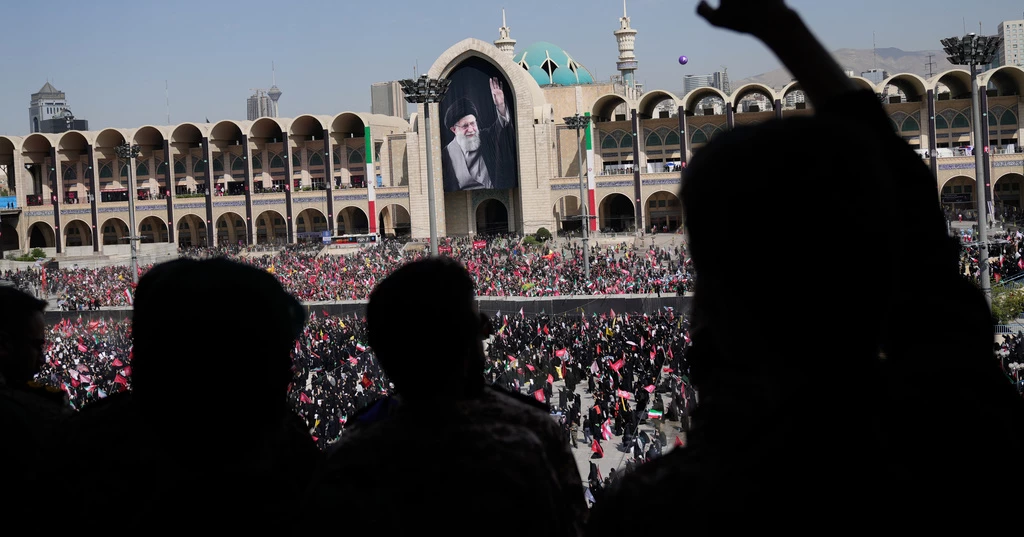
Hundreds of thousands of mourners gathered in Tehran on Saturday as Iran began a dayslong funeral for late Supreme Leader Ayatollah Ali Khamenei, beating their chests in grief before his flag-draped coffin and chanting calls for revenge against Israel and the United States.
Khamenei, who led Iran for decades, was killed at the age of 86 in a Feb. 28 airstrike during the opening phase of the Iran war.
The funeral is expected to strengthen support for Iran's ruling establishment and its new supreme leader, Ayatollah Mojtaba Khamenei, the late leader's son.
The ceremonies come at a critical time as Iran seeks to use its influence over the Strait of Hormuz in negotiations with the United States on a permanent end to the war, while concerns remain over the possibility of another Israeli attack.
During Saturday's ceremony, Iran's chief negotiator warned France and the United Kingdom against comments about launching joint naval patrols in the Strait of Hormuz, the narrow entrance to the Persian Gulf through which about one-fifth of the world's oil and natural gas once passed during peacetime.
Many mourners cried as they viewed Khamenei's coffin alongside those of family members who were also killed in the airstrike. Crowds repeatedly chanted, "Our word is one! Revenge! Revenge!" while carrying flags and banners bearing Khamenei's image. Groups of men beat their chests in a traditional Shiite mourning ritual.
"Imam Khamenei was our heart, our father, our everything," mourner Masoumeh Mohammadi said. "I still can't believe they martyred him. We will not rest until we avenge his death."
An outdoor stage at Tehran's Grand Mosalla was designed to resemble the setting where Khamenei had often delivered speeches. It featured a chair similar to the one he used, along with a microphone and a small table. Above the stage hung a portrait of Iran's first Supreme Leader, Ayatollah Ruhollah Khomeini, who died in 1989.
Khomeini's funeral drew millions of mourners and was marked by chaotic scenes. Khamenei's death, only the second time Iran has lost a supreme leader since the 1979 Islamic Revolution, allowed authorities several months to prepare for the ceremonies.
Volunteers sprayed water on mourners to help them cope with the summer heat, while food and drinks were distributed outside the venue. Men and women gathered separately inside the Grand Mosalla after passing through metal detectors and security checks. Armed police guarded nearby streets, while many people remained outside under the shade of trees after much of the city was shut down for the funeral.
The coffins of Khamenei's family members were placed beneath his own coffin, which was topped with his black turban, signifying his descent from the Prophet Muhammad. Among those killed was the wife of Mojtaba Khamenei. It remained unclear whether Mojtaba would appear at the funeral. Reports said he was wounded in the same airstrike that killed his father.
"We attended the funeral to show that we are all committed to defend our country and religion," said Ali Kazemi, who travelled from the northwestern city of Tabriz, about 530 kilometres (330 miles) from Tehran.
Iran began the funeral on July 4, the 250th anniversary of the founding of the United States. Although authorities did not mention the timing, crowds at the ceremony chanted, "Death to America!" and "Death to Israel!" The anti-American slogan has been common in Iran since the 1979 Islamic Revolution and the U.S. Embassy hostage crisis.
At about the same time, U.S. President Donald Trump, speaking in South Dakota near Mount Rushmore, said: "We knocked the hell out of Iran. They want to settle so badly. We gave them a week off for a funeral."
Some mourners at the Grand Mosalla also carried a large flag displaying the message "#KillTrump."
Meanwhile, Iran's chief negotiator Kazem Gharibabadi criticised a joint statement issued overnight by British Prime Minister Keir Starmer and French President Emmanuel Macron suggesting their militaries were prepared to help patrol the Strait of Hormuz.
Iran has sought to use control over the strategic waterway as leverage and has suggested charging ships that pass through it, challenging its long-standing status as an international waterway.
"The security of Hormuz lies with the coastal states. The crisis-makers will be held accountable for the consequences of their adventurism," Gharibabadi wrote on X. "This is a serious warning."
Khamenei's body will be taken to several cities in Iran and neighbouring Iraq before he is buried on Thursday at the Imam Reza shrine in Mashhad, his birthplace.
Authorities have closed roads, restricted airspace and suspended many daily activities during the mourning period.
No official estimate of Saturday's attendance was released, although large crowds continued to move through the Grand Mosalla and surrounding streets. Mourning ceremonies were also held in other cities across Iran.
A prayer for the dead is scheduled at the Grand Mosalla on Sunday. On Monday, Khamenei's body and those of his family members will be carried through the streets of Tehran in a procession expected to draw even larger crowds.
"I am here to say goodbye to my beloved leader Ali Khamenei," said 27-year-old Hananeh Mousavi, who attended the funeral with her mother. "I never expected to see such a day. I wish I had died before this tragedy."