
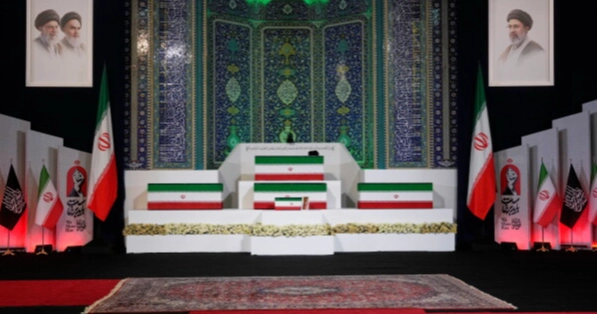
Iran is preparing for an extended funeral ceremony for Supreme Leader Ayatollah Ali Khamenei, who was killed during the recent war at the age of 86. Across Tehran, banners have been erected urging citizens to stand behind the Islamic Republic in the aftermath of the conflict.
State television broadcast footage of nighttime rallies in several Iranian cities, where crowds chanted slogans supporting the country's leadership while condemning the United States and Israel.
Authorities anticipate millions of mourners will gather in Tehran starting Saturday, drawing comparisons to the massive funeral held for Ayatollah Ruhollah Khomeini in 1989.
The large turnout is expected to reinforce the government's position as it seeks to use its strategic control of the Strait of Hormuz in negotiations with the United States over a lasting peace agreement. At the same time, officials remain concerned about the possibility of renewed Israeli military action.
Despite security concerns, a senior commander of Iran's Revolutionary Guard made his first public appearance in months during the funeral preparations. High-ranking government officials and foreign dignitaries are also expected to attend, highlighting the country's efforts to project unity and strength.
Volunteer Mohammad Hossein Rezaei said the nation would continue resisting foreign pressure and maintain the Islamic Republic's policy of independence. He emphasized that Iran's future would be determined by its own people rather than outside powers.
Coffin Displayed in Tehran
Khamenei's flag-covered coffin was placed at Tehran's Grand Mosalla alongside the bodies of several family members who were killed in the Israeli strike that marked the opening of the war on Feb. 28.
Among those honored were his son-in-law, eldest daughter, 14-month-old granddaughter, and the wife of Iran's new Supreme Leader, Ayatollah Mojtaba Khamenei. Mojtaba Khamenei, who reportedly suffered injuries during the attack, has remained out of public view.
Senior Iranian officials, including Parliament Speaker Mohammad Bagher Qalibaf, Foreign Minister Abbas Araghchi, and President Masoud Pezeshkian, paid tribute at the ceremony. Religious leaders and foreign guests also visited the coffin while prayers and military music accompanied the event.
State media also aired footage from a mourning ceremony held Thursday night, where grieving families threw scarves and personal items toward the coffin so attendants could touch them against it, a traditional practice believed to bring blessings.
Later, Khamenei's casket was draped with a red flag bearing the inscription "Ya Hussein," a Shiite symbol commemorating the martyrdom of Imam Hussein. The flag, brought from the Imam Hussein shrine in Karbala, Iraq, also represents unjust bloodshed and a call for justice.
Senior Military Figure Reappears
Iranian state media released images showing Gen. Ahmad Vahidi attending funeral planning meetings before appearing beside Khamenei's coffin during a private memorial service.
In remarks broadcast Friday, Vahidi declared that Khamenei's death would strengthen Islam and insisted that Iran would never surrender to external pressure. He said those hoping to see Iran weakened would be disappointed.
Analysts believe Vahidi has become a key figure in shaping Iran's negotiating strategy with the United States over ending the conflict. He had not been seen publicly since early February, before the war began. During the conflict, Israel killed several senior Iranian military and political leaders and has also threatened Mojtaba Khamenei. Vahidi is believed to be among the officials maintaining close contact with the new supreme leader.
It remains uncertain whether Mojtaba Khamenei will appear publicly at his father's funeral. His father had attended Ayatollah Khomeini's funeral in 1989, visibly mourning before assuming leadership of Iran.
Meanwhile, Iran's joint military command warned Israel and the United States against any actions that could escalate tensions during the funeral period.
Funeral Ceremonies to Continue for Several Days
Beginning Saturday, Iran will hold funeral ceremonies in multiple cities across the country as well as neighboring Iraq. Authorities are expected to close roads, restrict airspace, and suspend parts of daily life in Tehran to accommodate the large crowds.
Throughout the capital, banners and large displays featuring Khamenei's raised clenched fist have been installed, with imagery including ballistic missiles. In his first message to the nation, read on state television, Mojtaba Khamenei said his father died with his fist raised.
Banners displayed in Arabic, English, and Farsi carried the slogan, "We must rise."
Taxi driver Jafar Javadi said the raised fist symbolizes unity among Muslims and vowed that Iranians would continue expressing opposition to the United States and Israel while remaining steadfast in support of their country's leadership.