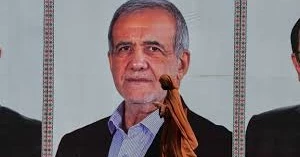
Iran’s president Masoud Pezeshkian arrived in Pakistan on Tuesday for high-level talks as diplomatic efforts between Tehran and Washington continue to draft a potential agreement aimed at ending the ongoing Middle East conflict, even as fresh violence erupted in Lebanon and key disagreements surfaced over what has actually been agreed so far.
Pezeshkian’s visit to Islamabad comes as technical-level negotiations continue following talks held in Switzerland on Monday, led by US Vice President JD Vance and Iran’s parliamentary speaker Mohammad Bagher Qalibaf. The discussions are part of a wider diplomatic push to finalise a long-term settlement to the war.
However, gaps in the understanding between the two sides have already emerged. In Tehran, Foreign Ministry spokesperson Esmail Baghaei said there are no planned visits by the UN nuclear watchdog, the International Atomic Energy Agency (IAEA), to inspect Iranian nuclear sites that were bombed by the United States last year. This contradicts earlier US claims that an agreement had been reached to allow inspections.
The IAEA has maintained limited access to Iran since the 2025 Israel–Iran war, but has not been permitted to enter the damaged enrichment facilities targeted by US strikes.
At the same time, renewed violence in southern Lebanon has added fresh uncertainty to the fragile diplomatic process. Israeli forces opened fire in separate incidents, killing two people, according to Lebanese authorities, raising fears that the escalation could undermine ongoing negotiations.
Iran has insisted that any comprehensive deal must include a full ceasefire in Lebanon, where fighting between Israel and Hezbollah has continued alongside broader regional tensions.
Talks in Islamabad amid tight security
Security was significantly heightened in Islamabad as Pezeshkian met Pakistani President Asif Ali Zardari and Prime Minister Shehbaz Sharif. This is his first visit to Pakistan since the conflict began following US and Israeli strikes on Iran in February.
Pezeshkian and Sharif are expected to hold a joint press conference after their talks.
Diplomatic efforts are now entering a 60-day phase aimed at shaping a permanent agreement. Both sides have reportedly agreed in principle to establish a “de-confliction cell” to manage the Lebanon conflict and reduce risks of escalation between Israel and Iran-backed Hezbollah.
US officials also said discussions included mechanisms to keep the Strait of Hormuz open, a critical global oil route that Iran had previously disrupted during the conflict.
Ahead of the visit, Pezeshkian stressed that progress depends on strict adherence to commitments.
“The effectiveness of the talks depends on full commitment to the agreed obligations and their precise implementation,” he wrote on X, adding that “statements outside the agreed text do not help advance the negotiations.”
Sanctions, nuclear issues and disputed interpretations
Iranian officials said the Switzerland talks led to the formation of several working groups covering sanctions relief, nuclear issues, reconstruction, and monitoring arrangements, according to state media IRNA.
Deputy Foreign Minister Kazem Gharibabadi, who is leading the technical talks, also said a coordination mechanism was created for shipping through the Strait of Hormuz and for managing the Lebanon conflict.
However, it remains unclear whether these arrangements will be enough to halt fighting on the ground, particularly between Israel and Hezbollah, which continues to operate in southern Lebanon.
Dispute over use of frozen Iranian assets
Another point of disagreement has emerged over Iran’s access to frozen funds. US Vice President JD Vance said any released Iranian assets would be used to purchase American agricultural products, including soy, corn and wheat, with oversight from the US and Qatar.
Iran rejected that interpretation. Foreign Ministry spokesperson Baghaei said Tehran alone decides how to use its funds and would base import decisions on price and quality.
He also criticised the US framing of the war’s outcome, saying it is ironic that a conflict “aimed at destroying Iran” has been turned into what he described as benefits for American farmers.
Iran’s ambassador in Geneva, Ali Bahreini, also disputed claims of external control over the funds, saying Iran alone has authority over its assets.
Lebanon ceasefire under strain
Mediators Pakistan and Qatar said the proposed coordination cell would include the Lebanese government and aim to enforce a halt to military operations. But Israeli Prime Minister Benjamin Netanyahu has raised doubts, saying Israel will maintain “full freedom of action” to respond to threats.
Neither Israel nor Hezbollah is part of the US–Iran negotiations. Netanyahu has vowed to continue military operations until threats in southern Lebanon are eliminated, while Hezbollah has said it will not stop attacks unless Israel withdraws.
US President Donald Trump said he would review the situation, adding that he expects the crisis to be resolved.
“I’m a problem solver, I get problems solved real fast,” he said.
The latest deadly incidents in Lebanon came after a brief lull following a ceasefire brokered on Saturday. While no airstrikes were reported for two days, tensions remain high, and both sides have continued to accuse each other of violations.
Separately, Lebanon and Israel are expected to hold another round of indirect talks in Washington focused on a possible Israeli withdrawal plan.