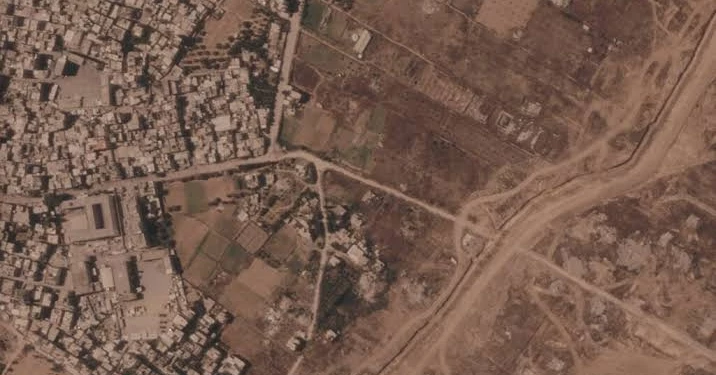
Israel has been rapidly constructing a large earthen barrier inside the Gaza Strip, according to satellite images, reinforcing its control over more than half of the territory and raising concerns that the temporary military line could become a more permanent boundary.
Satellite imagery reviewed by The Associated Press shows that more than 23 kilometres of the barrier have been built in recent months through areas where Palestinian communities were demolished. The structure stretches across much of Gaza, which is about 40 kilometres long and home to more than two million people.
The Israeli military confirmed it has built a physical barrier along the so-called "yellow line" — the area where its forces withdrew under the ceasefire agreement reached with Hamas in October. The line was intended to be a temporary military boundary until a broader Israeli withdrawal could take place.
However, with the ceasefire process stalled, many Palestinians fear the barrier could eventually become a permanent border dividing the enclave.
The Israeli military said it has also established a security zone along the line equipped with surveillance and other technology. It said the barrier is intended to prevent infiltration and protect Israeli troops and nearby Israeli communities but declined to say how far the construction will extend.
Construction progressing rapidly
Satellite images indicate the barrier is expanding quickly.
In southern Gaza, one section of the earthworks grew from about 500 metres to roughly 2.4 kilometres between July 1 and July 15, cutting across the area between the Israeli-controlled ruins of Rafah and the Muwasi area, where many displaced Palestinians are living in tent camps.
The longest continuous section of the barrier now stretches nearly 17 kilometres from Khan Younis toward Gaza City. Construction on that section began in February and has continued steadily, with more than one kilometre added between late June and early July.
Smaller, disconnected sections have also been built near the heavily damaged town of Beit Lahia in northern Gaza.
Large areas under Israeli control
Most of Gaza's population is now concentrated west of the yellow line, where many people are living in overcrowded tent camps and relying on humanitarian aid.
Satellite images show that on the Israeli-controlled side of the line, many towns, including much of Rafah, have been flattened by bulldozers and explosives. Roads, military bases and other infrastructure have been built in their place.
Israel says it is destroying Hamas infrastructure as part of its military operations.
The exact route of the yellow line has never been clearly defined. The Israeli military said it is working to mark the boundary more clearly to reduce accidental crossings.
Israeli forces have repeatedly opened fire on Palestinians approaching or crossing the area. The military says it targets people suspected of posing a threat, although reports indicate that civilians, including children, have also been killed near the line.
Ceasefire remains stalled
According to Palestinian health officials, more than 1,100 Palestinians have been killed by Israeli military operations since the ceasefire began, most in airstrikes and drone attacks. During the same period, militant attacks have killed five Israeli soldiers.
On Tuesday, an Israeli airstrike in Gaza City killed a couple and their four children, aged between 6 and 13, according to Shifa Hospital. The Israeli military said it had targeted Hamas militants operating in the area.
The ceasefire agreement calls for Israel to eventually withdraw its forces to the edges of Gaza, where an international security force would take over. However, implementation has stalled amid continued disagreements between Israel and Hamas.
Israel says Hamas has failed to disarm, while Hamas accuses Israel of violating the ceasefire.
The war began on Oct. 7, 2023, when Hamas-led militants attacked southern Israel, killing about 1,200 people and taking 251 hostages.
Since then, Israel's military campaign in Gaza has killed more than 73,000 people, according to the Gaza Health Ministry, which says women and children account for about half of the fatalities.