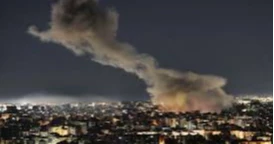
Israel on Monday ordered military strikes on Beirut’s southern suburbs after Hezbollah launched rockets toward northern Israel, including areas near the coastal city of Haifa, marking a further escalation despite an existing ceasefire.
In a joint statement, Israeli Prime Minister Benjamin Netanyahu and Defence Minister Israel Katz accused Hezbollah of repeatedly violating the ceasefire and targeting Israeli cities and civilians. They said the military had been instructed to strike targets in Beirut’s southern suburbs, known as Dahiyeh, a Hezbollah stronghold.
The announcement prompted many residents to flee the area, causing heavy traffic on roads leading out of the suburb.
The latest developments came a day after Israeli ground troops advanced deeper into southern Lebanon than at any time in the past 26 years.
Overnight Israeli airstrikes on southern Lebanon killed six people, including a Syrian national near the city of Nabatiyeh, according to Lebanon’s state-run National News Agency.
The Israeli military said it intercepted two projectiles fired from Lebanon and also neutralised a suspicious aerial target near areas where Israeli forces are operating in southern Lebanon. No casualties were reported.
Hezbollah claimed responsibility for a series of rocket and missile attacks on northern Israel on Sunday.
The renewed hostilities occurred despite a ceasefire that has been in place since April 17 and ahead of a new round of talks between Lebanese and Israeli officials scheduled to begin in Washington on Tuesday.
The negotiations, which started in April, are the first direct discussions between the two countries in more than three decades. Hezbollah has opposed direct talks and continues to rely on diplomatic pressure from Iran, which is also engaged in discussions with Washington regarding regional tensions.
Although Beirut has largely been spared airstrikes since the ceasefire took effect, two targeted attacks struck the city’s southern suburbs in May.
According to a US official, Secretary of State Marco Rubio recently spoke with Lebanese President Joseph Aoun and Israeli Prime Minister Benjamin Netanyahu to explore a framework aimed at sustaining negotiations and reducing tensions.
Under the proposal, Hezbollah would cease attacks on Israel while Israel would avoid escalating military operations in Beirut. However, Lebanese Parliament Speaker Nabih Berri reportedly insisted that Israel must first halt its military actions.
Berri, a close ally of Hezbollah, said the group was prepared to fully comply with a ceasefire but questioned who would ensure Israel ends its attacks.
President Aoun condemned what he described as ongoing Israeli aggression and said his government remains committed to ending the suffering of the Lebanese people, particularly in the south.
The latest conflict between Israel and Hezbollah has killed more than 3,400 people in Lebanon and displaced over one million others.
Israel's military also reported that one soldier was killed overnight in a Hezbollah drone attack in southern Lebanon. According to Netanyahu's office, at least 26 Israeli soldiers, a defence contractor and two civilians have been killed since the fighting intensified.