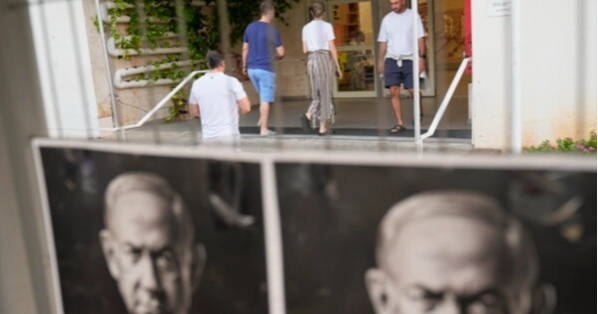
Israelis went to the polls on Tuesday in a crucial election that could end Prime Minister Benjamin Netanyahu’s long tenure, as the country remains deeply divided after years of conflict, the October 2023 Hamas attack and ongoing debates over its political and national identity.
Netanyahu, Israel’s longest-serving prime minister, is facing a challenge from several political parties seeking to remove him from office, with opinion polls indicating a close contest involving his main rival, former military chief Gadi Eisenkot. More than seven million people are eligible to vote, with tens of thousands reportedly returning from abroad to participate.
Security and national defence have dominated the campaign inside Israel, while international criticism over the war in Gaza and violence by Jewish settlers in the occupied West Bank has raised concerns about Israel’s global standing and the safety of Jewish communities worldwide.
Israel’s fragmented parliamentary system makes it difficult for any single party to secure an outright majority. Neither Netanyahu’s religious and ultranationalist alliance nor the parties seeking to replace him may win enough seats to form a government independently, potentially leading to weeks of coalition negotiations.
Arab-led parties in Israel could play a decisive role in determining the next government if other political groups agree to cooperate with them.
Mansour Abbas, leader of the Islamist Ra’am party, expressed confidence while casting his ballot, saying the election would bring a change in government. He also hoped voter turnout in Arab communities would exceed 70 per cent. Arab citizens account for around one-fifth of Israel’s population.
Far-right National Security Minister Itamar Ben-Gvir warned that Abbas could end up influencing the next government if Netanyahu and his allies failed to secure victory. Ben-Gvir has drawn criticism for his treatment of Palestinian detainees and remarks dehumanising Palestinians in Gaza.
According to preliminary figures from the Central Elections Committee, nearly 17 per cent of eligible voters had cast their ballots within the first three hours of voting.
Emotions run high as voters head to polls
The election has stirred strong emotions among voters. In Kiryat Shmona, a town near the Lebanese border considered a Netanyahu stronghold, one voter was seen kicking and tearing down a campaign poster of Eisenkot.
The vote is Israel’s first national election since the Hamas-led attack on October 7, 2023, which triggered the war in Gaza and a wider regional conflict.
In Tel Aviv, families of people killed in the attack and former hostages observed a moment of silence in remembrance of the victims. Yona Adam, whose daughter Mapal Adam was killed, urged people to remember those who had lost their lives.
Eisenkot visited communities attacked on October 7 early Tuesday, criticising the government for failing to take responsibility for the security failures surrounding the assault. He said government officials should have begun election day by visiting the communities near Gaza that were targeted.
Netanyahu had not appeared in public during the first three hours after polling stations opened.
Around 330,000 young Israelis are eligible to vote for the first time, many of them facing compulsory military service amid continuing security challenges.
Tensions with Iran have also featured prominently in the campaign. Netanyahu intensified his warnings to Tehran ahead of the election, threatening a devastating response if Iran attacked Israel.
Security, military service and democracy at stake
Beyond choosing a government, the election is widely viewed as a referendum on Netanyahu’s leadership and Israel’s future direction — whether the country should move further towards religious and nationalist politics or strengthen its liberal and secular democratic traditions.
Israel has faced growing international isolation over its military campaign in Gaza and its policies in the occupied West Bank. Public support for Israel in the United States has declined, while several European and other international partners have imposed sanctions.
Netanyahu’s supporters regard him as an experienced statesman who has guided Israel through multiple conflicts. They credit him with protecting the country’s Jewish identity and restraining what they consider excessive intervention by the judiciary.
His opponents, however, accuse him of deepening political divisions, prolonging the Gaza war and the hostage crisis for political survival, and undermining judicial independence and democratic institutions. They also criticise his government for maintaining arrangements that allow many ultra-Orthodox Jewish men to avoid compulsory military service.
“The present government is driving the country into the ground,” said Angela Bengur, a voter in Jerusalem.
Eisenkot’s supporters see him as a credible alternative with extensive military experience who could help counter what they regard as growing authoritarian tendencies. The conflict has also affected him personally, as his son and two nephews were killed in Gaza.
Parties expected to support Eisenkot have pledged to restore Israel’s international standing, strengthen judicial independence and increase military enlistment among ultra-Orthodox men.
For many voters, compulsory military service has become a central election issue.
The election is about “who serves and who evades service — who takes an active part in building this country and who doesn’t,” said Nisso Shitrit, a voter in Jaffa.