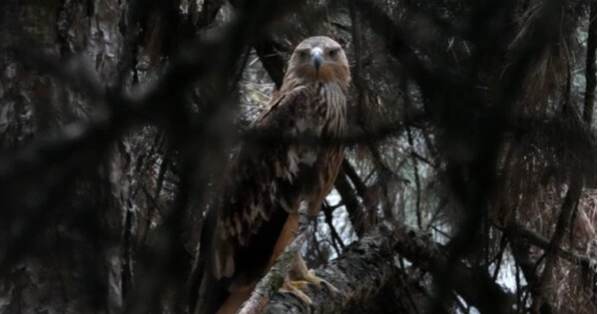
A young eastern imperial eagle named Feliks has returned safely to Serbia after being captured by poachers, illegally traded across the Middle East and rescued through a complex cross-border operation involving wildlife activists, refugees and the Serbian military.
The one-year-old eagle began his first migration to the Middle East last August but disappeared after his tracking signal was lost in Syria in late October.
Wildlife experts later discovered that Feliks had been captured by poachers and offered for sale through illegal wildlife trading networks.
His rescue has drawn attention to the growing problem of illegal wildlife trafficking and the efforts of conservation groups working to stop it.
"It's getting worse year after year," said Michel Sawan, head of the Lebanese Association for Migratory Birds, who helped coordinate the rescue. He said the successful mission exceeded expectations.
Feliks belongs to the protected eastern imperial eagle species, which was once on the brink of disappearing from Serbia. In 2017, only one breeding pair remained, but conservation efforts by the Bird Protection and Study Society of Serbia (BPSSS) have helped increase the population.
Before his migration, Feliks was fitted with an identification ring and a satellite transmitter that allowed researchers to monitor his journey.
He first flew across North Macedonia, Greece and Turkey before reaching Syria, where his signal suddenly disappeared.
According to Sawan, poachers in Syria often trap migratory birds by placing water in desert areas, using nets, shooting them or even chasing them with motorcycles.
After being captured, Feliks was advertised for sale in online groups used for illegal wildlife trading.
Sawan contacted people he knew in Syria and began efforts to recover the bird. He refused to pay smugglers but continued working through local contacts.
Feliks was first sold to a buyer in Lebanon and later taken back into Syria before conservationists managed to recover him.
Transporting the eagle into Lebanon proved difficult because of regional fighting and poor weather.
Eventually, a group of refugees carried Feliks across the Nahr al-Kabir River, which forms part of the Syria-Lebanon border, hidden inside a potato sack.
After reaching a bird sanctuary in Beirut, Feliks faced another challenge. The outbreak of war involving Iran in February complicated plans to fly him back to Serbia.
Following three unsuccessful attempts, the Serbian military arranged his return using a transport aircraft serving troops in a United Nations peacekeeping mission in Lebanon.
Feliks finally arrived back in Serbia on June 22.
He is now being kept in quarantine for 21 days at a zoo in northern Serbia before being released back into the wild with a new tracking transmitter.
Conservationists say the eagle still faces threats in Serbia, including accidental poisoning and collisions with power lines, despite years of successful efforts to restore the species.
The BPSSS, supported by a European Union-funded project, has helped increase the country's eastern imperial eagle population from a single breeding pair in 2017 to 29 breeding pairs today.
Researchers hope Feliks will soon return safely to the skies and continue his life in the wild.