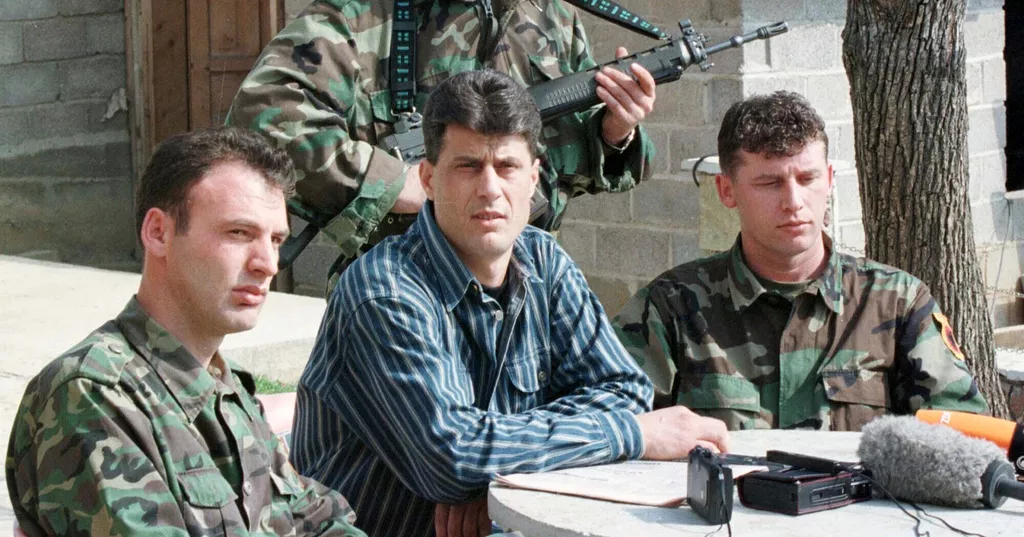
Kosovo’s former President Hashim Thaci was sentenced to 25 years in prison on Wednesday after being convicted of war crimes committed during the 1998-99 war for independence from Serbia.
Thaci stepped down from the presidency nearly six years ago to face charges before the European Union-backed Kosovo Specialist Chambers in The Hague. He was found guilty on four counts of war crimes, including murder, torture, cruel treatment and arbitrary detention.
Both Thaci and prosecutors, who had sought a harsher sentence, have the right to appeal.
The verdict triggered anger among Thaci’s supporters and dealt a major blow to a man who was once strongly supported by Western countries, was invited to the 1999 peace talks in France and was viewed as a leader capable of guiding Kosovo toward independence.
Presiding Judge Charles Smith said Thaci had actively participated in and encouraged crimes, including by promoting people involved in criminal acts. He also said Thaci “showed a ruthless ability to remove and eliminate political impediments” to his own leadership and that of other commanders.
Wearing a suit and tie, Thaci stood silently as Smith announced the sentence.
Supporters condemn verdict
Kosovo Foreign Minister Glauk Konjufca condemned the verdicts as “a terrible judgment for Kosovo, for our people and for our liberation war.”
Hundreds of Thaci supporters gathered at a park near the courthouse in The Hague, with some briefly clashing with Dutch riot police. Police said on X that two people were detained.
In Kosovo’s capital, Pristina, thousands watched the hearing live on a large screen and reacted with shock to the sentence. Some shouted “UCK,” the Albanian-language acronym for the Kosovo Liberation Army, which Thaci led before entering politics.
Bekim Fetahu, one of the supporters, described the verdict as “a catastrophic decision.”
“They (judges) have put the victims together with the aggressors,” Fetahu said.
Later, masked protesters threw stones at the compound of the European Union Rule of Law Mission in Kosovo, known as EULEX, on the outskirts of Pristina, breaking several windows.
Judge says trial focused on Thaci’s responsibility, not KLA’s legitimacy
Judge Smith said Thaci “used his position, leadership, authority and standing” to encourage crimes and failed to investigate or punish abuses committed by KLA fighters.
The American judge, however, emphasized that the trial was “not about the legitimacy of the Kosovo Liberation Army” or its ultimate objective of achieving independence for Kosovo, which was then a province of Serbia.
Specialist Prosecutor Kimberly West welcomed the judgment.
“Certain individuals exploited those war circumstances to commit grave crimes, and it is to the credit of Kosovo that those individuals are now being held accountable,” she said in a statement.
In Belgrade, Serbian President Aleksandar Vucic said, “we have no reason to rejoice,” while expressing concern that the verdict might not survive the appeals process.
Vucic also criticized the failure to consider several other alleged crimes against ethnic Serb civilians, alleging anti-Serb bias.
“No responsibility has been established for the toughest crimes,” he said. “Serbs are always (war) criminals and others are liberators and heroes.”
Thaci was tried alongside three other former KLA leaders who fought Serbian forces during the 1998-99 conflict and are widely regarded as national heroes in Kosovo. All four pleaded not guilty to the charges.
The court acquitted them of six charges of crimes against humanity, ruling that prosecutors had failed to prove the crimes were part of a widespread and systematic attack against civilians.
However, they were convicted of war crimes involving the arbitrary detention of 385 people, cruel treatment of 49, torture of 303 detainees and the murder of 96 people.
Thaci and the other defendants — Kadri Veseli, Rexhep Selimi and Jakup Krasniqi — continued to maintain their innocence.
Veseli was sentenced to 18 years in prison, Selimi to 13 years and Krasniqi to 25 years.
Veseli’s lawyer, Rodney Dixon, described the verdict as “not a good day for Kosovo. It’s not a good day for the rule of law or international law.”
He said he would “mount a robust appeal to continue the fight to show Mr. Veseli’s innocence and to bring him home to Kosovo.”
Thaci remained defiant throughout trial
At the conclusion of his trial in February, Thaci told the judges: “Throughout my life, I stood with the people of Kosovo, defending freedom, life and dignity. I was always guided by the Western ideals of democracy, equality and justice.”
The court, however, ruled that Thaci and his co-defendants had targeted political opponents and civilians whom they regarded as collaborators and traitors during their time in the KLA.
“In reality, there is no indication that the victims in this case were spies or collaborators,” Smith said. He added that simply having “Serbian friends or jobs in Serbian companies was enough to treat them as collaborators” with the enemy.
When the war began, Thaci was a student who returned from what he described as political exile in Switzerland to join Kosovo’s independence struggle. He was given the nickname “the Snake” for his ability to evade Serbian forces during the conflict.
Thaci became a prominent political figure after the war but resigned as president to defend himself before the court in The Hague.
Esther Major, Amnesty International’s deputy regional director for Europe, said the convictions “show that senior officials are not above the law.”
About 13,000 people were killed during the Kosovo war, most of them ethnic Albanians. A 78-day NATO air campaign against Serbian forces brought the conflict to an end, while about 1 million ethnic Albanian Kosovars were forced from their homes.
Kosovo declared independence from Serbia in 2008, but Belgrade has refused to recognize it. Relations between Kosovo and Serbia remain tense despite years of EU-mediated negotiations backed by the United States.