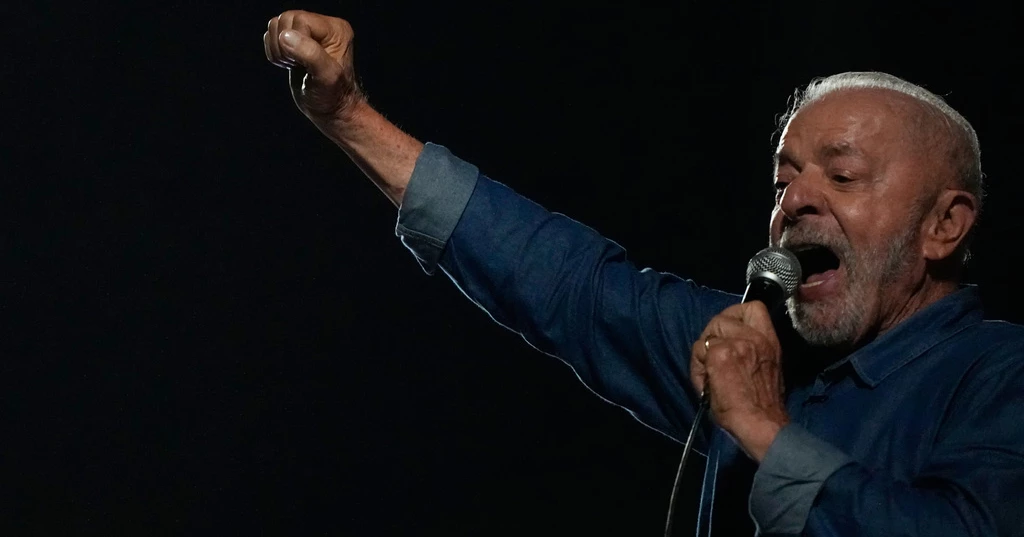
Brazilian President Luiz Inácio Lula da Silva’s comeback victory in Sunday’s presidential runoff is already facing its first hurdle, as his rival, Sen. Flávio Bolsonaro, challenges the results, setting the stage for a possible confrontation between the country’s two polarising political forces.
Lula, who persuaded an additional 10.4 million voters to support him in the runoff, is expected to take office on Jan. 5, 2027, for his fourth non-consecutive term. He will serve as a counterweight in a region where leaders are moving to the right and aligning with US President Donald Trump. Bolsonaro, the son of former President Jair Bolsonaro, has promised to strengthen ties with the Trump administration.
At a news conference on Sunday, Bolsonaro said he planned to seek the annulment of the election following a chaotic extension of voting at the request of both candidates. However, it remains unclear what legal grounds he could use to pursue such a move. His father also challenged his defeat to Lula four years ago and is now serving a 27-year prison sentence for attempting a coup.
Early indications from Brazilian institutions and leaders across the region, including conservative presidents opposed to Lula, suggest the results will be respected both domestically and internationally. Trump has yet to comment.
Despite the extension of voting, Lula secured a decisive victory. The soon-to-be 81-year-old incumbent received more than 64 million votes, compared with just under 60 million for Bolsonaro, a margin of nearly 4%.
Kassio Nunes, head of Brazil’s electoral authority and a Supreme Court justice appointed by former president Jair Bolsonaro, was among those who acknowledged Lula’s victory on Sunday.
“This is a really uphill battle for Flavio Bolsonaro. Important Brazilian power brokers are closing ranks behind Lula, sometimes begrudgingly,” said Brian Winter, a Brazil analyst and editor-in-chief of Americas Quarterly.
“I sense that Brazilian power brokers that matter don't really want to go down the path of a truly contested election,” he said.
The numbers behind Lula’s victory
The key to Lula’s victory was the additional 14.1 million voters who turned out for the second-round election, including those who had supported other candidates in the first round. Analysts said three-quarters of those votes went to Lula, securing his win.
Notably, the first round recorded a record number of Brazilians choosing not to vote, while the second round saw the lowest number of abstentions ever.
Lula entrusted his digital campaign to lawmaker André Janones, who ran an aggressive and sustained social media operation that mobilised many previously undecided voters. Janones’ main tool was a channel on the messaging app WhatsApp called “Lula’s Army”, which attracted nearly 11 million people and encouraged them to campaign for the incumbent on social media.
Janones “basically embraced the right's style of aggressive politics, very intense, constant messaging,” said Oliver Stuenkel, a professor of international relations at Fundação Getulio Vargas in Sao Paulo.
“The defeat in the first round jolted the Lula campaign into action. The strategy during the first round was lackluster and saw a lot of infighting,” Stuenkel said.
Juliano Cortinhas, a professor of international relations at the University of Brasília, said Lula’s social media campaign during the runoff also played a key role in pressuring Meta, the owner of Instagram, WhatsApp and Facebook, to address what Lula’s campaign had denounced as bias favouring Bolsonaro.
Brazil’s top electoral court ruled on Oct. 15 that Meta must take measures to ensure equal treatment of the two presidential candidates. The company later said it had addressed the issue.
“There was external interference we were suffering by major platforms,” Cortinhas said. “It wasn't only Meta, many others were using their algorithms to repost many images and many messages of the far-right, and they did not do the same to the left.”
It was the first time since 1989 that a candidate who trailed in the first round went on to win the second round.
The results showed that voter turnout increased overall, particularly in wealthier metropolitan areas. However, Lula made his biggest gains in lower-income municipalities where he already had a strong support base. He mobilised former non-voters, people who had cast blank ballots in the first round and supporters of third-party candidates.
Jorge Henrique Oliveira Sena, a 26-year-old maintenance worker in Brasilia, was among those who skipped the first round. Although neither candidate particularly appealed to him, he voted for Lula.
“It's not a question of supporting, but between the two, I had more of a connection with him,” he said.
Brazil’s voting system and Sunday’s disruptions
Brazil holds general elections every four years, and its electronic voting machines have made the counting process both quick and secure.
The authorities introduced electronic voting machines in the 1990s to combat fraud, and the system has largely proved reliable since then. Election results are usually reported within hours of polling stations closing.
Ahead of the 2022 election, Jair Bolsonaro repeatedly raised unfounded doubts about Brazil’s electronic voting system. No significant fraud has ever been detected.
However, the usually swift voting process was disrupted on Sunday after a last-minute decision to extend voting nationwide at the request of both candidates.
Lula sought the extension because of public transport problems in the metropolis of Sao Paulo and the northeastern city of Salvador, two of his strongholds. Bolsonaro requested it following heavy rains in the south, where he had won by a wide margin in the first round.
A Supreme Court justice made the decision just minutes before polls were due to close at 5pm. Because Brazil’s vote-counting process is so fast, many polling stations did not receive the news until they were already preparing to close.
Nevertheless, given the reliability of Brazil’s voting system and Lula’s substantial margin of victory, Bolsonaro could face difficulties finding a legal path to annul the results.
Benjamin Gedan, a senior fellow and director of the Stimson Center’s Latin America programme, said Bolsonaro’s rejection of his defeat was unsurprising.
“False claims of fraud are becoming commonplace, though that does not make them any less dangerous,” he said, pointing to “Lula's margin of victory, and the quick recognition of the result by conservative leaders in the region.”
Despite his victory, Lula still faces significant challenges, including political polarisation, a possible fiscal crisis and a right-wing Congress in which Bolsonaro’s party will hold more seats than any other party. Bolsonaro remains a senator, although his term ends in January.
“We shouldn't underestimate the power of the Bolsonaro family,” Winter said. “They can make life difficult for Lula for weeks and months to come.”