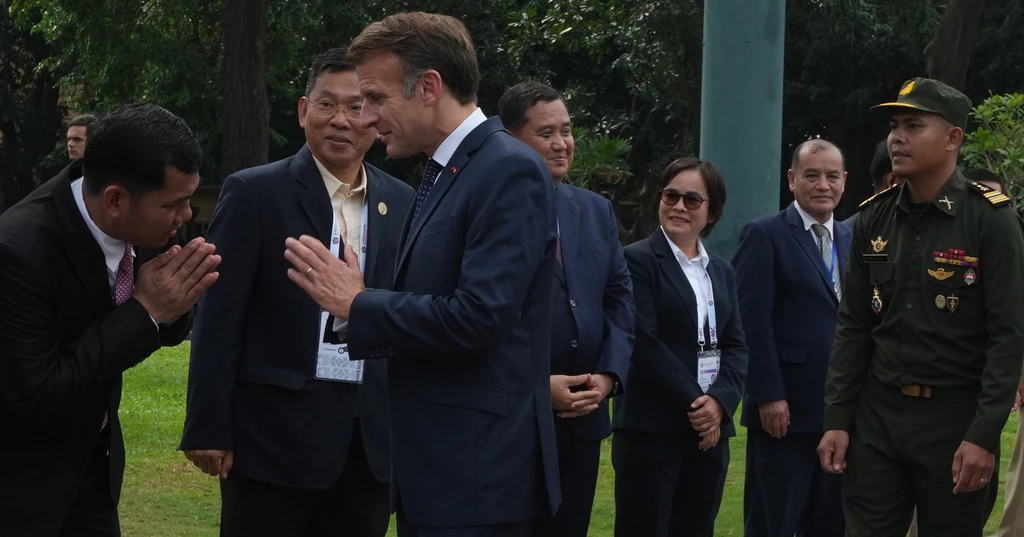
French President Emmanuel Macron left the Francophonie summit in Cambodia on Monday with uncertainty still surrounding the leadership of the French-speaking organisation after a dispute between Rwanda and Congo disrupted the proceedings.
Following intense negotiations over the weekend and into Monday, member states agreed that incumbent Secretary-General Louise Mushikiwabo of Rwanda would remain in office for another year before a new leader is selected.
Mushikiwabo was seeking a third term at the summit, but Congo strongly opposed her reappointment and even threatened to withdraw from the Organisation internationale de la Francophonie (OIF) if she was reelected.
With a population of more than 110 million, significantly larger than France's 70 million, Congo's withdrawal would deal a major blow to the organisation.
Congo, the United States and UN experts have accused Rwanda of supporting the M23, one of around 100 armed groups seeking control in mineral-rich eastern Congo along the Rwandan border. Rwanda has consistently denied providing support to armed groups operating in Congo.
The French president's office welcomed the decision to postpone the leadership change for a year, saying it would help the organisation "to overcome divisions and preserve the consensus in the francophone family."
Congo's Foreign Minister Thérèse Kayikwamba Wagner also welcomed the arrangement, describing it in a post on X as "a wise compromise" that would help maintain unity within the Francophonie.
The OIF concluded its three-day meetings on Monday. Macron held bilateral discussions with several leaders, including Cambodian Prime Minister Hun Manet and Vietnamese leader To Lam, and attended the summit of the organisation, which comprises 90 member states and governments, including 53 full members, five associate members and 32 observers.
On Sunday, the French president's office said Macron had met Rwandan President Paul Kagame and urged the three African countries putting forward candidates for the OIF leadership — Rwanda, Congo and Mauritania — to hold discussions and reach a "consensus solution."
France holds considerable influence in the organisation as its largest contributor to the 2026 OIF budget of 71.7 million euros ($79 million).
The leadership controversy follows the withdrawal of Mali, Niger and Burkina Faso from the OIF, announced in March 2025 after their memberships were suspended over military coups.
Meanwhile, rights organisations and UN Special Rapporteur Tom Andrews urged world leaders attending the summit to press Cambodia to release rights activists and ensure greater democratic freedoms in the country, which operates as a de facto one-party state.
Cambodia-Thailand tensions feature during Macron's visit
Cambodia's dispute with Thailand also drew attention during Macron's visit.
Prime Minister Hun Manet, who chaired the summit, criticised Thailand in his opening address on Sunday and reiterated that Cambodia had not initiated the fighting between the two Southeast Asian neighbours in 2025 over competing claims to border territories.
The clashes killed several dozen civilians and soldiers on both sides and displaced hundreds of thousands of people.
Macron praised Hun Manet for choosing peace as the summit's theme and said France supported renewed dialogue to achieve a peaceful, negotiated settlement of border disputes.
In a Facebook post on Sunday, Thai Prime Minister Anutin Charnvirakul said Thailand had "always respected all agreements with Cambodia and will always adhere to international law."
He also reiterated Bangkok's position that bilateral disputes should be settled without third-party involvement.
Thailand's reluctance to involve outside parties is partly linked to two rulings by the International Court of Justice granting Cambodia ownership of a centuries-old temple on disputed land along the border.
Macron inaugurates restored temple before leaving for Malaysia
Before departing for Malaysia, Macron visited Siem Reap on Monday, where he joined Cambodian King Norodom Sihamoni in marking the completion of a French-supported restoration project at the West Mebon temple near the Angkor Wat complex, a UNESCO World Heritage site.
Cambodia's Apsara National Authority told The Associated Press that the restoration of the 11th-century temple, built during the Angkor era, cost $12 million and took 14 years to complete.
The joint French-Cambodian project involved transporting replacement stones and heavy machinery by boat to the island temple while managing water levels to prevent flooding during seasonal rains.
The temple had suffered damage from natural elements, human activities and war.
Macron arrived in Malaysia later on Monday and was scheduled to meet Prime Minister Anwar Ibrahim for talks expected to focus on defence cooperation and the supply of critical minerals.
His Southeast Asian tour comes amid widespread protests in France, where more than 600,000 people took to the streets earlier this month demanding higher wages and expressing support for the country's student protest movement.
The demonstrations have resulted in thousands of arrests, hundreds of injuries and several schools being set on fire.