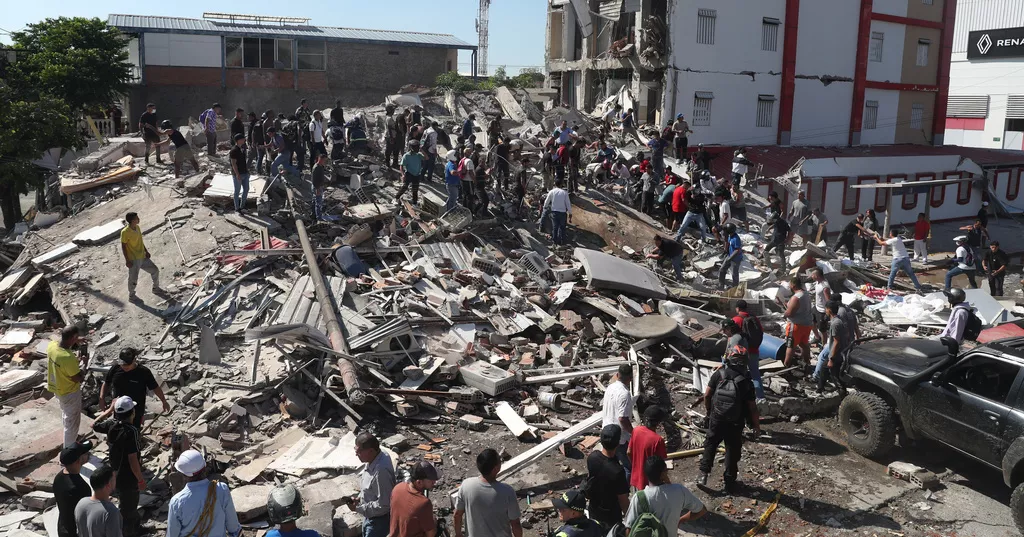
A powerful 7.4-magnitude earthquake struck western Colombia on Monday, killing at least 111 people and damaging hundreds of buildings, President Abelardo de la Espriella said.
The president declared a state of emergency to speed up funding for recovery efforts and said he would travel to the disaster zone, which is centered in the rural Choco region.
The earthquake’s epicenter was in San Jose del Palmar, a community of about 4,800 people in Choco, roughly 250 miles (400 kilometers) west of Bogota, according to the U.S. Geological Survey and Colombia’s geological agency. The USGS said the quake struck at a depth of 66 miles (107 kilometers). Tremors were also felt in neighboring Ecuador and Panama, although only limited damage was reported there.
Before the death toll was revised to 111, local authorities had confirmed at least 40 deaths in Risaralda, where the badly affected city of Pereira is located, and 27 in Valle del Cauca, home to Colombia’s third-largest city, Cali. At least three of those killed in Valle del Cauca were children, the governor said.
Authorities also reported nine deaths in Choco, two in Caldas and one involving a 73-year-old man in Antioquia. Many others were injured across the country.
The earthquake devastated cities in western Colombia, including Pereira, Quibdo, Cali and Manizales. Residents and rescue crews searched through the rubble of collapsed buildings as authorities warned of possible aftershocks. Colombia’s interior minister said more than 20 municipalities had been affected.
The Pacific region around the quake’s epicenter lies along the “Ring of Fire,” a belt of seismic faults surrounding the Pacific Ocean where most of the world’s earthquakes occur. Choco is among Colombia’s poorest regions, and much of the densely forested area is rural and accessible only by boat or plane, potentially making it difficult for authorities to determine the full extent of the damage and casualties.
Strongest earthquake in Colombia in a decade
Jorge Moncayo, a 64-year-old taxi driver in Cali, said he saw clouds of dust rising across the city as buildings collapsed. Residents and rescue workers were searching through the debris for survivors.
“My entire house shook. I’ve never lived through such a powerful earthquake,” he said. “We’re thanking God we’re alive.”
Colombia’s Geological Service said the quake was the strongest recorded in the country over the past decade. It was followed by two aftershocks measuring 2.8 and 4.8 in magnitude.
Authorities also suspended flights at airports in Manizales, Quibdo, Armenia, Cartago, Buenaventura and Pereira.
The disaster further unsettled Colombians following two consecutive earthquakes that devastated neighboring Venezuela in late June, destroying hundreds of buildings and killing more than 5,000 people. As buildings collapsed in Colombia, families in Venezuela were still searching through the ruins for the remains of loved ones.
In Pereira, photos and videos published by local media showed sections of the airport ceiling collapsing onto travelers who had taken shelter, while people screamed and ran through the debris.
Pereira Mayor Mauricio Salazar told a local radio station that at least 18 people had died and many others were trapped beneath “a massive quantity of collapsed buildings.”
In nearby Manizales, a city in Colombia’s coffee-producing mountains, one of the towers of the neo-Gothic cathedral collapsed onto the nave. Mayor Jorge Eduardo Rojas urged residents to remain outside because of the risk of aftershocks.
Authorities in rural Choco, where the earthquake was centered, reported injuries and damage to buildings in the regional capital but provided few details.
In Cali, a city of about 2 million people, Mayor Alejandro Eder said residents were trapped in at least 19 collapsed buildings.
Powerful earthquakes rare in Colombia
Small earthquakes, locally known as “temblores,” are common in central and western Colombia, but quakes above magnitude 6.0 are rare. A 6.2-magnitude earthquake near Armenia in 1999 killed more than 1,100 people.
President de la Espriella said Monday that he had personally taken charge of the government’s response to the emergency in San Jose del Palmar.
“You are not alone. The state is present and taking action,” he said.
The earthquake response represents the first major challenge for de la Espriella, a Trump ally who was sworn in as president over the weekend.
Messages of support came from leaders across the Americas, including Mexico, Brazil, Ecuador, El Salvador and the United States.
“The Trump administration is closely monitoring the large earthquake that struck Colombia and stands ready to support the people of Colombia,” U.S. Secretary of State Marco Rubio wrote on X.
Several countries offered assistance, while U.N. deputy spokesman Farhan Haq said the United Nations was “ready to help as needed.”