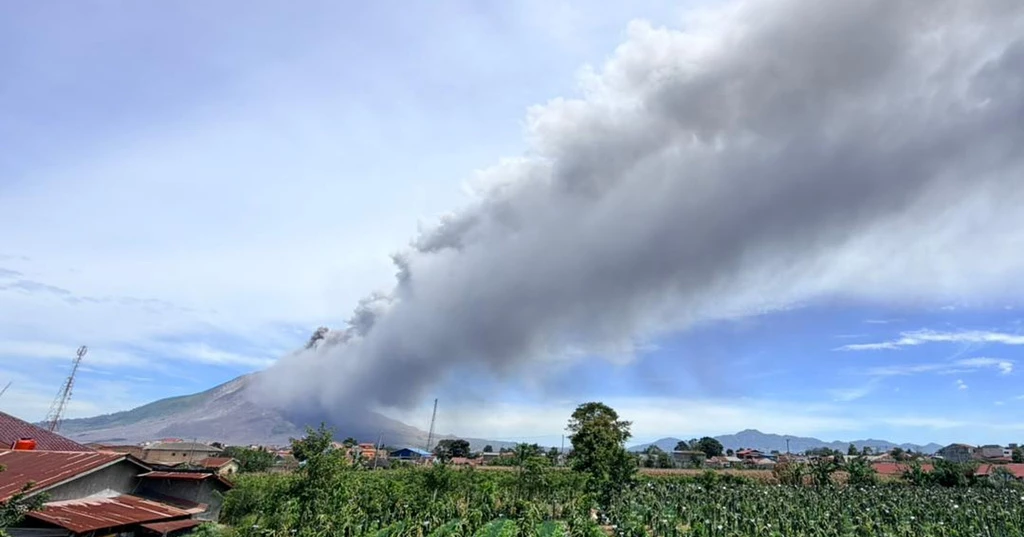
Mount Sinabung in Indonesia erupted Monday, sending a column of black ash and smoke about 3,500 meters (11,482 feet) above the mountain on Sumatra island.
There were no immediate reports of casualties, evacuations or flight disruptions in the area.
However, residents, visitors and tourists were advised to avoid activities in nearby villages in Karo district of North Sumatra province and within a 6-kilometer (3.7-mile) radius of the volcano’s summit.
Gray volcanic ash covered roads, vehicles and buildings in several villages in Karo following the eruption. Local authorities distributed masks among residents as a precaution.
Officials raised the volcano’s alert status to “Watch,” the second-highest level for volcanic activity, thereby expanding the restricted area around the 2,600-meter (8,530-foot) mountain.
“This eruption is considered an initial eruption, and it is possible that a larger eruption could occur,” Lana Saria, head of Indonesia’s Geological Agency, said in a statement Monday.
The agency had earlier documented signs of increased activity at Mount Sinabung in mid-August, including dozens of earthquakes, and expanded the recommended radius for public activities around the volcano.
Around 30,000 people have been forced to leave their homes in areas surrounding Sinabung over the past several years because of volcanic activity.
Indonesia, an archipelago nation of more than 280 million people, experiences frequent seismic activity and is home to more than 120 active volcanoes.
The country is particularly vulnerable to earthquakes and volcanic eruptions because it lies along the Pacific “Ring of Fire,” a zone of volcanoes and fault lines encircling the Pacific Basin.