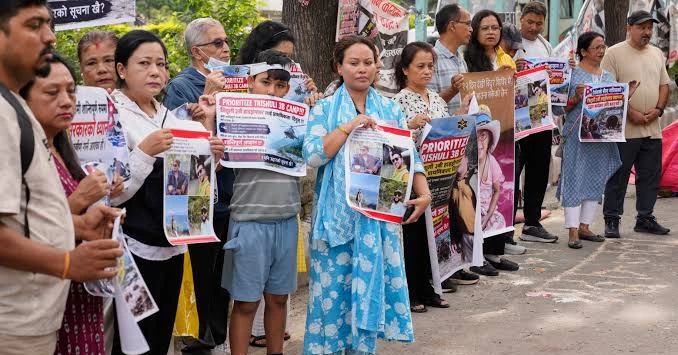
Nepal observed a national day of mourning Monday for victims of the Aug. 26 floods, with government buildings flying flags at half-staff as families completed traditional mourning ceremonies.
Monday marked the 13th day since the devastating floods that killed more than 1,300 people across Nepal and Tibet and left around 5,000 others missing, including foreign nationals, according to Nepal’s disaster management authorities.
In predominantly Hindu Nepal, families traditionally observe a 13-day mourning period. During this time, immediate relatives generally remain at home while others visit to offer condolences. The final day is marked by religious rituals and prayers for the souls of those who died.
Some families whose relatives are still missing also carried out symbolic funeral ceremonies. Cremation is a significant Hindu funeral tradition, and holding the ritual without recovering a loved one’s body can offer families a degree of emotional and spiritual closure.
The government officially declared Monday a day of mourning and instructed government offices to lower their flags to half-staff.
At the same time, search and rescue operations for those still missing continued, although some families criticized authorities for what they described as an inadequate response.
In Kathmandu, relatives gathered outside the offices of the prime minister and several key ministries, urging the government to intensify efforts to locate hundreds of workers from hydropower projects who were swept away by the Bhotekoshi River or buried beneath landslides and debris.
Among the protesters was Sumana Shrestha, who held a poster featuring a photograph of her 55-year-old husband. He has been missing since the day of the floods.
Shrestha said her husband, a consulting geologist, had told the family he would return home after finishing his shift at the Trishuli hydropower project. However, the two-and-a-half-story project office was completely buried under debris.
“We are here because we have not heard of any rescue attempt on this project, but it has been 13 days already,” she said. “All we can do is pray and hope for a miracle.”
Another protester, Mahesh Prasad Shrestha, displayed a photograph of his 52-year-old brother, Niraj Shrestha, an engineer who worked at the same site. He said authorities did not send a small excavator by helicopter until the sixth or seventh day following the disaster. He argued that Nepal should have requested larger helicopters from countries such as China or India to transport heavier rescue equipment.
Authorities said rescue operations have concentrated on 12 hydropower projects, where about 900 workers remain missing and an estimated 500 may be trapped inside tunnels. Specialist teams from India, China, South Korea and the United States have joined the search, working through debris, damaged buildings and underground tunnels.
Two Nepali workers were rescued from one of the facilities on Friday, while rescuers recovered a Chinese national from the site on Saturday.