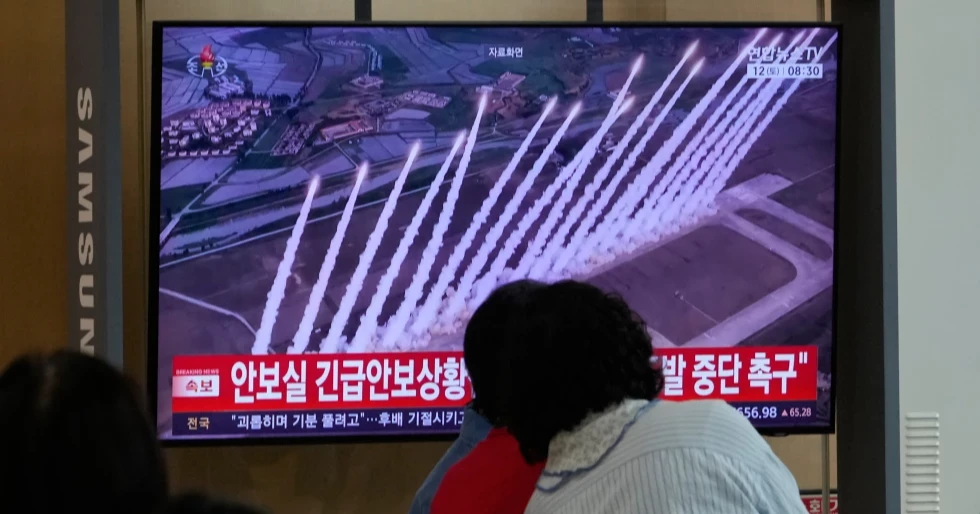
North Korea said Monday that it had conducted a joint live-fire exercise involving missiles, artillery and drones, claiming the drill demonstrated the weapons’ “huge destructive power.”
The exercise involved the simultaneous firing of various weapons systems, apparently aimed at enhancing North Korea’s ability to overwhelm the air defenses of South Korea and the United States.
Experts said North Korea appears to be continuing its weapons testing despite US President Donald Trump’s recent decision to scale back a major military exercise with South Korea in an apparent bid to revive diplomacy with North Korean leader Kim Jong Un.
The North’s official Korean Central News Agency said the drill, held Saturday, was designed to train an integrated weapons control system.
South Korea’s military earlier said it detected several short-range ballistic missile launches from the Wonsan area on North Korea’s eastern coast on Saturday morning.
North Korean Marshal Pak Jong Chon, who observed the exercise, said the drill would “improve the level of specialization to bring down the enemy’s armed forces organizationally and structurally once an order is issued.”
The weapons systems deployed during the exercise demonstrated “the huge destructive power of concentrated fire,” Pak said, according to KCNA.
North Korea’s claims about its weapons tests cannot be independently verified.
South Korea’s Joint Chiefs of Staff said several missiles launched Saturday traveled about 250 kilometers (155 miles) toward waters off North Korea’s east coast. The range indicates that the weapons are capable of striking targets in South Korea, including US military installations.
The exercise marked North Korea’s first publicly reported ballistic missile launches in about three weeks. It came a day after the United States, South Korea and Japan concluded a trilateral military exercise that Pyongyang considers a provocation.
In August, Trump instructed the Pentagon to “substantially reduce” a major joint military exercise with South Korea, citing what he described as a good relationship with Kim.
North Korea rejected the gesture, saying the reduction in the exercise’s duration did not alter what it called its “provocative, aggressive nature.” The Ulchi Freedom Shield exercise ultimately ended six days earlier than initially planned.
Experts said Kim may believe he has greater leverage in any potential negotiations with Washington because of his expanding nuclear arsenal and stronger ties with Russia and China than he did when he first held summits with Trump in 2018 and 2019.
Kim said earlier this year that he could resume talks with the United States if Washington abandons what he calls its “hostile policy” toward North Korea and recognizes the country’s claimed status as a nuclear state.