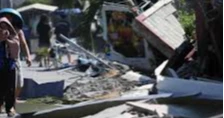
The mayor of a southern Philippine municipality severely affected by a powerful earthquake has appealed for the immediate deployment of helicopters to deliver food and relief supplies to villages cut off by landslides.
The 7.8-magnitude offshore earthquake struck Monday near the southern province of Sarangani, making it one of the strongest tremors to hit the Philippines in the last 50 years. The disaster has claimed at least 47 lives, injured 688 people and left 31 others missing.
More than 45,000 residents remained displaced as of Thursday, with roughly half taking shelter in evacuation centers. Authorities said over 12,600 homes were damaged across several farming towns and urban areas, while ongoing aftershocks have discouraged many families from returning home.
Sarangani recorded the highest death toll among affected areas, with 20 fatalities. Most of the deaths were linked to a landslide that buried homes in the coastal town of Glan, according to the Office of Civil Defense.
Glan Mayor Victor James Yap said electricity has yet to be restored, and 10 of the town’s 31 villages remain largely inaccessible because of landslides. He urged the national government to dispatch military helicopters to transport food, drinking water and emergency supplies to isolated residents.
According to Yap, relief efforts are being hampered by damaged roads and blocked routes, leaving some communities without adequate access to basic necessities. He warned that food shortages were becoming critical in several villages.
Although a major road leading to the town has been reopened, allowing fuel deliveries to resume, power outages persist and mobile phone services remain unreliable in many areas.
The Office of Civil Defense said the government has distributed more than 26 million pesos (about $426,000) worth of food packs, cash assistance and other relief items. It added that 180 aircraft, helicopters, ships and trucks have been mobilized to support rescue and recovery operations.
Around 3,400 government workers and military personnel are engaged in search-and-rescue missions, road-clearing efforts, damage assessments and other emergency response activities.
President Ferdinand Marcos Jr. visited General Santos City on Wednesday to inspect damaged schools and hospitals and review recovery measures. He approved the release of 100 million pesos (about $1.6 million) for repairs to the partially damaged city hall and ordered financial assistance of 50,000 pesos ($820) for each family that lost a loved one in the disaster.
Most fatalities were caused by collapsing structures and landslides in Sarangani, General Santos City, South Cotabato and Davao Occidental.
The earthquake also triggered hazardous sea conditions. Two swimmers drowned and another remains missing after being swept away by strong waves off General Santos shortly after the tremor. Waves reaching up to 1.4 meters above normal tide levels were recorded in southern Philippines, while smaller waves reached parts of Indonesia, Palau and southern Japan.
The quake ranks among the strongest to strike the Philippines since the devastating 8.1-magnitude earthquake and tsunami of August 1976, which killed an estimated 8,000 people.
Located along the Pacific Ring of Fire, the Philippines frequently experiences earthquakes and volcanic activity due to its position on a major zone of tectonic movement.