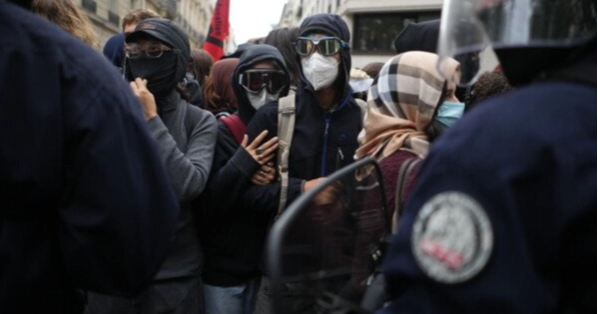
Police fired tear gas Thursday after dozens of students built new barricades outside a high school in northeastern Paris, as nationwide protests over education funding showed no sign of slowing.
Students dragged rubbish bins into place outside the Helene Boucher Lycee early in the morning. The school has become a major site of clashes in the French capital and was among hundreds affected by protests across the country.
At least a dozen demonstrations in support of the student movement were scheduled in different parts of France later Thursday.
Riot police gathered in nearby streets as students arrived at the school. Many protesters wore surgical masks or hoodies, apparently to avoid being identified.
According to the Interior Ministry, police have arrested more than 6,600 people since late September, when students, most of them under 18, began protesting for increased education funding.
The Education Ministry said 375 schools were fully or partially closed Thursday.
Pressure grows on government
Although the number of affected schools was lower than Tuesday, the protests are increasing pressure on the government of outgoing President Emmanuel Macron.
The demonstrations began over inadequate funding for schools, many of which face deteriorating facilities and staff shortages. The movement has also attracted unions and political groups, as well as people who are not involved in the protesters' main demands.
Prime Minister Sebastien Lecornu criticized the violence in a televised address, citing attacks on students and school staff, injuries to police and gendarmes, vandalized or burned schools, lost class hours, threats and insults.
He also accused political leaders of using public anger for electoral purposes ahead of France's presidential election in April.
“We cannot play with the safety of France's youth,” Lecornu said.
At the Helene Boucher Lycee, 18-year-old university student Emma Khelil, a former student at the school, joined protesters to show her support. She said she was particularly concerned about police violence.
“We're here to defend our rights, not to lose an eye or a hand,” Khelil told The Associated Press.
Khelil also said the school had insulation problems and water leaks and that she had occasionally seen rats there. Other students said they had also seen rats.
She said Lecornu's efforts were unlikely to end the protests.
“I don't think the movement is going to lose momentum. As long as things don't change, we're going to see the movement grow stronger, and potentially a convergence of struggles, especially with the next presidential election coming up,” she said.
Shortly afterward, police surrounded a nearby square as the crowd surged. Officers then fired tear gas.
Protests spread to Belgium
The unrest in France has also affected neighboring Belgium.
Liege Mayor Willy Demeyer banned public gatherings until midnight on Oct. 16, citing a “real, serious and imminent risk” of further clashes and vandalism in the coming days.
Belgian police used water cannon and tear gas Wednesday to disperse several hundred protesters. Authorities also sent emergency text messages advising shopkeepers to close their businesses because of the rioting.
Nearly 90 people were arrested and several police officers were injured. Reinforcements were brought in from Brussels and Antwerp, with more expected. Smaller demonstrations were also held in Mons and Charleroi.
Belgian Interior Minister Bernard Quintin said on social media that those responsible for the unrest would face legal consequences.
The protests in Belgium were organized through social media chat groups. Demonstrators are demanding more teachers and smaller classes and protesting education reforms. However, the movement also appears to have been influenced by the unrest in France.