
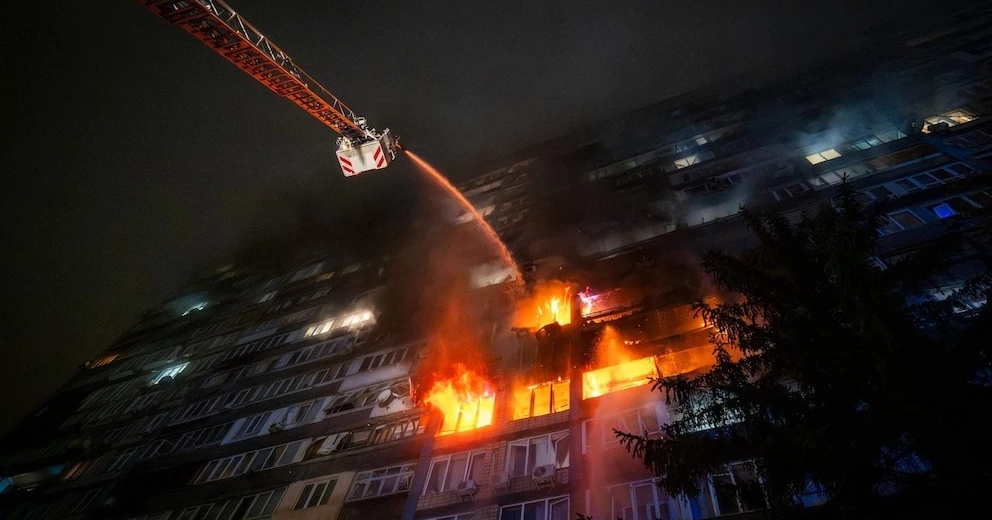
Power was restored to over 800,000 residents in Kyiv on Saturday, a day after Russia launched major attacks on Ukraine’s energy grid, causing widespread blackouts, while European leaders moved forward on plans to use hundreds of billions of frozen Russian assets to support Ukraine’s war effort.
Ukraine’s largest private energy company, DTEK, said the “main work to restore the power supply” was complete, though some localized outages continued in the capital following Friday’s “massive” Russian strikes.
The attacks, carried out with drones and missiles, wounded at least 20 people, damaged residential buildings, and triggered blackouts across large parts of Ukraine. Prime Minister Yulia Svyrydenko described the assault as “one of the largest concentrated strikes” on Ukraine’s energy infrastructure.
Russia’s Defense Ministry claimed the strikes targeted energy facilities supplying Ukraine’s military, using Kinzhal hypersonic missiles and strike drones, without providing details of the facilities hit.
Since Russia’s full-scale invasion more than three years ago, Ukraine’s energy sector has been a repeated target, particularly ahead of winter, with attacks intended to undermine public morale. Winter temperatures in Ukraine typically run from late October to March, with January and February being the coldest months.
Ukrainian President Volodymyr Zelenskyy, in his nightly address, accused Russia of taking advantage of the world’s focus on the Middle East and called for stronger air defense systems and tighter sanctions on Russia. “Russian assets must be fully used to strengthen our defense and ensure recovery,” he said in a video posted on X.
Meanwhile, British Prime Minister Keir Starmer, French President Emmanuel Macron, and German Chancellor Friedrich Merz issued a joint statement pledging to move toward using frozen Russian sovereign assets in a coordinated way to support Ukraine’s armed forces, in close cooperation with the United States.
Ukraine’s estimated budget and military needs for 2026–27 are around €130 billion ($153 billion). The EU has already contributed €174 billion ($202 billion) since the war began. Frozen Russian assets are estimated at €194 billion ($225 billion) in Belgium, $50 billion in Japan, and smaller amounts in the U.S., U.K., and Canada.Ukraine’s air force reported intercepting or jamming 54 of 78 Russian drones overnight, while Russia claimed to have shot down 42 Ukrainian drones over its territory.