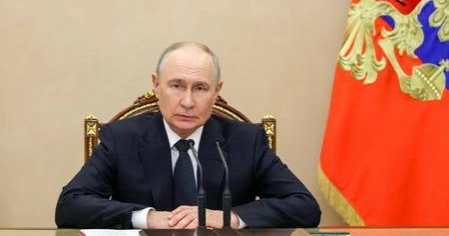
Russian President Vladimir Putin has signed a decree allowing the government to temporarily take control of critical infrastructure if private owners fail to adequately protect their facilities from Ukrainian drone attacks or restore them after strikes.
The move comes as Russia faces mounting economic and political pressure from increasingly frequent and precise Ukrainian attacks deep inside its territory.
Ukraine has used domestically produced long-range drones to target major oil facilities, contributing to fuel shortages, as well as important commercial and industrial sites. At the same time, Russian airstrikes have caused extensive damage to Ukraine’s power infrastructure and homes ahead of winter, with the war now in its fifth year.
The Kremlin has not clearly explained the broader purpose of the decree, which was announced late Monday. It covers a range of facilities, including energy and fuel installations, industrial sites, communications networks, and transport and logistics infrastructure.
Deputy Prime Minister Denis Manturov said the measure does not amount to nationalization or a transfer of ownership. Rather, he described it as allowing the state to temporarily participate in the management of companies to address specific security concerns.
Manturov stressed that the mechanism would not be used broadly and that decisions would be made selectively at the highest level.
Pressure on owners to restore damaged facilities
Russian political analyst Abbas Gallyamov said the decree could be intended to pressure owners of repeatedly targeted oil refineries to finance repairs.
He noted that some facilities had been struck several times, potentially making owners reluctant to spend billions of rubles rebuilding them if they could be attacked again.
Gallyamov suggested the government was effectively warning companies that if they failed to fund the restoration of damaged refineries, the state could step in and take control.
Ukraine continues strikes on Russian oil facilities
Ukraine’s General Staff said Tuesday that its forces had attacked facilities at Russia’s Afipsky oil refinery in the Krasnodar region overnight, causing a fire. Krasnodar Governor Veniamin Kondratyev also confirmed that a fire had broken out at an oil refinery in Afipsky.
The repeated attacks are adding to Russia’s economic difficulties as the war continues to consume state resources. Moscow has increased taxes and domestic borrowing to manage its budget deficit, while state control of major companies could potentially generate additional revenue.
However, taking responsibility for damaged infrastructure could also increase the financial burden on the government. The new measure may therefore be aimed partly at encouraging private companies to take greater responsibility for protecting their facilities against drone attacks.
Russia’s huge territory makes comprehensive air-defense coverage difficult, and officials have increasingly called on businesses to strengthen their own defenses.
More support for businesses hit by strikes
The government has also introduced measures to assist Russia’s largest online retailer, Wildberries, and thousands of businesses that sell products through the platform. Ukrainian attacks on warehouses have caused significant damage to the company and its sellers.
The Finance Ministry proposed Monday extending deadlines for tax and insurance payments to provide Wildberries and affiliated sellers with additional financial relief.
Putin said Saturday that Russia needed to improve its air-defense capabilities following Ukrainian strikes deep inside the country.
He also called for closer coordination among defense, law-enforcement and civilian agencies and urged greater use of the resources of state-owned enterprises and private businesses.
In May, Russian lawmakers approved legislation allowing the Central Bank, state-controlled Sberbank and several other financial institutions to install air-defense systems at their facilities to protect against drone attacks.
Russian news outlet RBC also reported in May, citing unnamed sources in and close to the Defense Ministry, that a mechanism had been created to enable businesses to purchase weapons and equipment for protection against Ukrainian drone attacks.
The developments reflect Moscow’s growing efforts to involve private companies in the protection of critical infrastructure as Ukrainian drone attacks reach deeper into Russian territory.