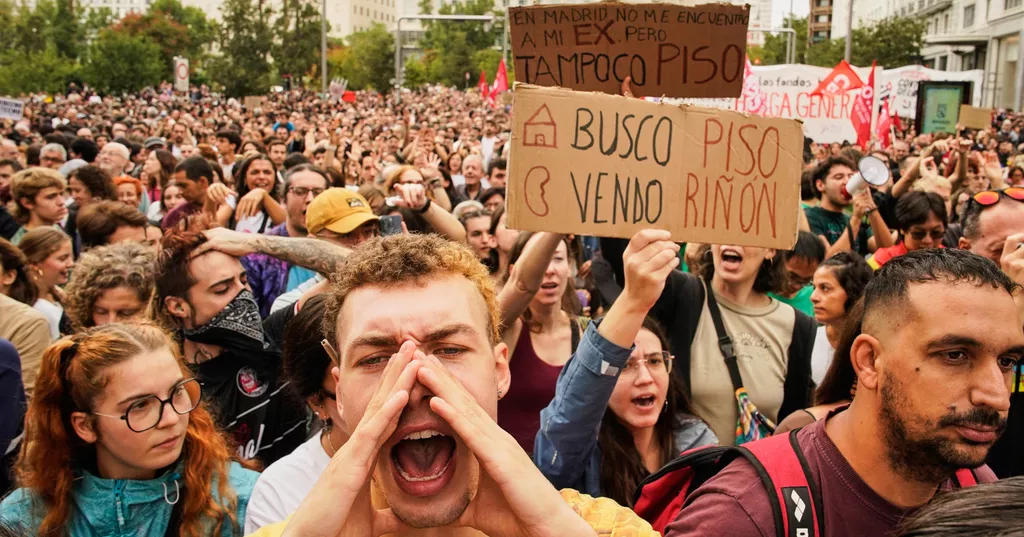
Tens of thousands of people took to the streets across Spain on Saturday demanding affordable housing and greater protection for renters, a day after parliament rejected emergency measures proposed to address the country's housing crisis.
Large crowds marched in Madrid, where protesters called for a general strike and affordable housing. In Valencia, police fired tear gas and rubber bullets after demonstrators broke through a security perimeter around the City of Arts and Sciences, where a real estate summit was taking place.
Images showed clashes between police and protesters, with officers using batons and demonstrators throwing barriers. There were no immediate reports of injuries.
The protests intensified after the eviction of 87-year-old María del Carmen Abascal, known as Maricarmen, from her Madrid home of seven decades on Sept. 23.
About 1,000 protesters have camped for the past week at Madrid's Puerta del Sol, demanding government action to protect tenants. A similar camp has been set up at Barcelona's Plaza Catalunya.
Abascal, who uses a wheelchair, was carried from her apartment on a stretcher after police cordoned off the street. Images of the eviction triggered protests across the country.
“I haven’t managed to defend my home, but I have fought so that others can learn to fight for what’s theirs,” Abascal said in a video recorded from a hospital bed.
The real estate company seeking to evict her so it could rent the property at a higher price later reached an agreement allowing her to return, according to her lawyer. Abascal was “happy,” the lawyer said, although she has not yet been discharged from hospital.
The incident has become a symbol of Spain's housing affordability crisis, with protesters carrying signs reading “Not even one more Maricarmen!”
Prime Minister Pedro Sánchez's progressive government had proposed measures to restrict evictions, curb property speculation and give renters indefinite leases. But conservative opposition parties joined forces in parliament on Friday to reject the measures.
The defeat has increased pressure on Sánchez, who faces a national election next year, and fueled speculation that he could call an early election to rally left-wing voters around the housing issue.
Spain's housing shortage has been worsening for years, particularly affecting young people and low-income households who cannot afford to buy homes and face a limited rental market.
Average rents have nearly doubled over the past decade, with the average price rising from 8.20 euros per square meter in 2016 to 15.10 euros this year, according to real estate website Idealista.
The government says 26 percent of Spaniards who rent spend an average of 40 percent of their income on rent and utilities, compared with 18 percent across the European Union.
Spain also has one of the smallest stocks of government-owned rental housing among OECD countries, accounting for less than 2 percent of available homes, compared with an EU average of 8 percent.
Housing protests have periodically taken place in major Spanish cities, with demonstrators blaming property speculation and tourist rental platforms such as Airbnb for driving up rents.
The latest demonstrations have given the issue renewed momentum, with protesters saying Maricarmen's case shows the need for stronger tenant protections.