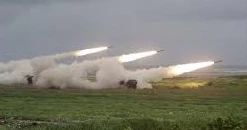
Taiwan’s military on Wednesday launched rockets in the direction of China using US-supplied mobile launchers in a drill designed to simulate how the island would respond to a potential Chinese attack.
The exercise featured the High Mobility Artillery Rocket System (HIMARS), which was fired for the first time into waters of the Taiwan Strait, the narrow waterway separating Taiwan from mainland China. The system had been tested previously, but not in this specific live-fire setting.
A military official said the drills reflect Taiwan’s determination to strengthen its defence capabilities amid rising tensions.
“Due to the current enemy threat, we will continue HIMARS training with unwavering determination to protect Taiwan as the nation’s strongest force,” said army Sergeant Wang Ming-hui.
The military said it used reduced-range training rockets that fell into the sea shortly after launch.
China, which claims Taiwan as part of its territory, regularly sends military aircraft and naval vessels near the island and has stepped up large-scale drills in recent years. The United States does not recognise Taiwan as an independent state but opposes any attempt to change its status by force and remains its key arms supplier.
HIMARS, a truck-mounted mobile rocket system, is designed for rapid deployment, allowing forces to fire from hidden positions and quickly relocate, a tactic known as “shoot-and-scoot.”
The system was the centrepiece of the second day of Taiwan’s west coast exercises, which also included 155mm howitzers. The drills simulated a response to a possible Chinese invasion and focused on speed, precision and mobility.
During the exercise, the HIMARS units moved into position after receiving firing orders and launched rockets within minutes, demonstrating rapid strike capability.
In December, the United States announced plans to sell 82 additional HIMARS units to Taiwan as part of a major arms deal. However, the package has reportedly been put on hold following recent diplomatic talks between US President Donald Trump and Chinese President Xi Jinping.