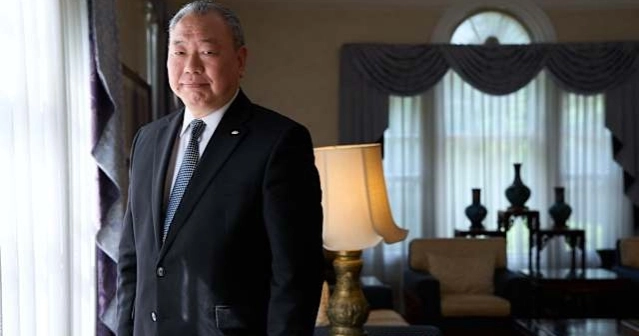
Taiwan needs to continue buying US weapons to strengthen its self-defence capabilities as military pressure from China increases, the island’s top envoy in Washington has said, while noting that US policy toward Taiwan remains unchanged.
Alexander Yui Tah-ray, head of the Taipei Economic and Cultural Representative Office in the United States, said Taiwan is focused on boosting its defence spending and military readiness.
“We need those arms for defensive purposes,” Yui told The Associated Press in an interview in Washington on Wednesday. “We’re trying to increase our defence expenditure. We try to increase our ability to defend ourselves better and survive times of crisis.”
A proposed $14 billion US arms package for Taiwan remains under review, creating uncertainty in Taipei. The issue gained attention after President Donald Trump, following a visit to Beijing in May, said he had discussed the deal in detail with Chinese President Xi Jinping.
The Trump administration has yet to advance the package, which had previously received approval from senior lawmakers. Trump has described the deal as a potential “very good negotiating chip” in dealings with China.
Under US law, Washington is required to provide Taiwan with sufficient defence equipment to deter any aggression from China, which considers the self-governed island part of its territory and has not ruled out using force to achieve unification.
China has consistently opposed US arms sales to Taiwan, which has never been governed by Beijing.
Yui said Taiwan cannot rely on outside support alone for its security.
“This is our responsibility, so we will not wait and depend on the US cavalry to come and save us,” he said, adding that Taiwan is actively purchasing US weapons to strengthen its defence.
He said arms purchases must match the level of threat, which he described as “very high,” pointing to near-daily Chinese military activity around the island.
China regularly sends warships and military aircraft near Taiwan and has staged large-scale military drills in recent years. Beijing views the island as a core national interest and has warned against support for Taiwanese independence.
Yui said there has been no change in Washington’s official position on Taiwan and that Taipei respects the Trump administration’s approach and timing on policy announcements.
US Secretary of State Marco Rubio has also said that Washington’s policy on Taiwan remains unchanged and that arms deals are not negotiated with China. He said the proposed package is still under review, partly due to concerns over US weapons stockpiles following recent global commitments.
A separate $11 billion arms deal for Taiwan was approved in December, including rocket systems and artillery equipment.
Yui, who arrived in Washington in 2023, is now working under the second Trump administration, which has taken a more flexible approach in relations with Beijing compared to earlier tensions.
Despite shifting rhetoric, he expressed confidence in US-Taiwan ties, saying what matters most is policy action rather than statements.
“The big stick is still there,” he said.