
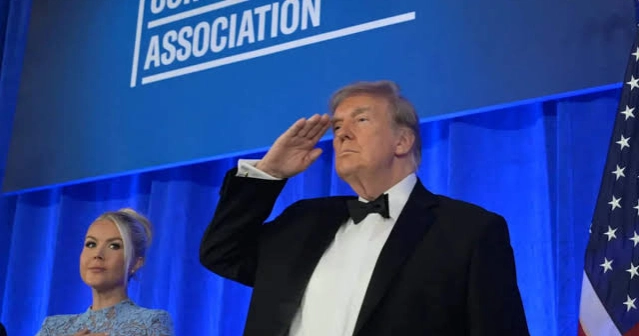
President Donald Trump attended the rescheduled White House Correspondents' Association (WHCA) dinner on Friday, declaring, “The show must go on,” three months after the original event was disrupted by a shooting.
Held at the Waldorf Astoria under heightened security, the scaled-down event brought together about 700 journalists, government officials and guests. Attendees passed through multiple security checks, including ID verification, armed officers and detection dogs, with no red carpet or pre-dinner receptions.
WHCA President Weijia Jiang opened the evening by acknowledging the trauma of the April incident and reaffirming the association’s commitment to press freedom. “We are back,” she said. “We will not be intimidated. We refuse to let an act of violence have the final word.”
Trump, who had previously hinted he might deliver a combative speech, instead mixed humor with criticism of the media. He joked that the ballroom contained “the largest group of ‘Trump Derangement Syndrome’ people put together at one time” before sitting through more than an hour of journalism awards, including honors for reporters recognized for investigative coverage of his administration.
The dinner also introduced two special awards. One honored Secret Service agent Victor Gonzales, who was injured while protecting attendees during the April shooting, while another recognized the staff of the Washington Hilton, the original venue where the incident occurred.
The WHCA said the decision to reschedule the event reflected its commitment to celebrating a free press and ensuring that violence would not overshadow the role of journalism.
Despite the event’s return, criticism persisted. Media ethics experts and some journalists argued that the annual dinner creates the appearance of journalists becoming too friendly with the public officials they cover. Others questioned holding the event amid escalating tensions between the Trump administration and the news media.
The renewed scrutiny comes as the administration continues to face criticism over actions affecting the press, including legal disputes involving journalists and growing concerns about press freedom. A coalition of media organizations and former journalists urged the WHCA to use the dinner to publicly challenge what they described as efforts to undermine the First Amendment and independent journalism.