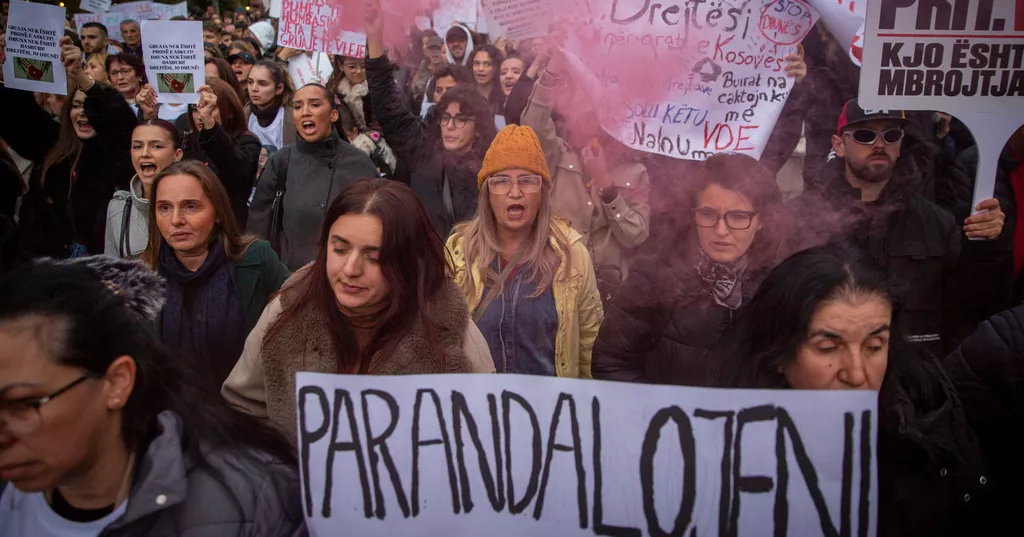
Thousands of people took to the streets of Kosovo's capital on Wednesday, demanding government action against widespread violence against women, as protesters splashed red paint on government buildings to accuse authorities of failing to prevent the killings.
The demonstration in Pristina followed the killing of Arlinda Zekaj, 49, by her brother-in-law on Sunday near the western town of Peja. Activists said she was the eighth woman killed in domestic violence in Kosovo this year.
The protesters, expressing anger over what they described as the state's failure to protect women in the traditionally patriarchal Balkan country, carried banners reading, "Do we have to die to be taken seriously?"
Other messages painted in red included "Men kill women, the state stays silent" and "Down with the patriarchal system." Demonstrators also carried photographs of the women who had been murdered.
Kosovo has enacted several laws and regulations to tackle violence against women, including life imprisonment for murderers. However, activists say the measures are not consistently enforced and that police, social services, prosecutors and courts often fail to coordinate their responses.
Similar problems persist across the Balkans, where male dominance remains deeply rooted in tradition. Violence against women increased following the wars of the 1990s, amid political, economic and social crises that have continued in the region.
Zekaj's killing, which sparked widespread public outrage, was particularly disturbing because she had previously appealed to authorities for protection, warning that her life was in danger. She held both US and Kosovo citizenship.
In a letter to the chief prosecutor's office just three days before her death, Zekaj complained that officials were "shifting responsibility from one to another," allowing the threat to her life to persist.
She had repeatedly reported violence by her husband and moved to her parents' home while seeking protection.
After her husband was detained last weekend over family violence, Zekaj returned to her home. According to a relative, police did not provide an escort, and her brother-in-law killed her with an axe when she arrived.
The suspect fled after the killing and was arrested several days later after remaining on the run. He faces allegations of murder with a sharp object. Neither he nor the husband has commented on the allegations.
The Kosovo Women's Network, one of the organisations behind the protest, said the case raised serious concerns about possible institutional failures.
"This case raises serious questions about a possible failure in the chain of institutions," the group said, stressing that all relevant authorities must work together when a woman seeks help.
In response to the killing, Kosovo's Parliament held an emergency session on Monday and formed a parliamentary investigative committee to examine whether institutions had failed in their responsibilities.
Prime Minister Albin Kurti also criticised the authorities, describing the case as a "systemic chain of failures by the institutions responsible for security and justice."
"A murder preceded by such warnings that went unanswered could hardly have ended any other way," Kurti told a government session on Wednesday. "And that makes the situation even more unforgivable."
According to the Justice Ministry, police recorded 2,815 reports of domestic violence in Kosovo in 2025. The country has a population of around 2 million.
Since life imprisonment for murder was introduced in 2012, three men have received the sentence for killing their partners.