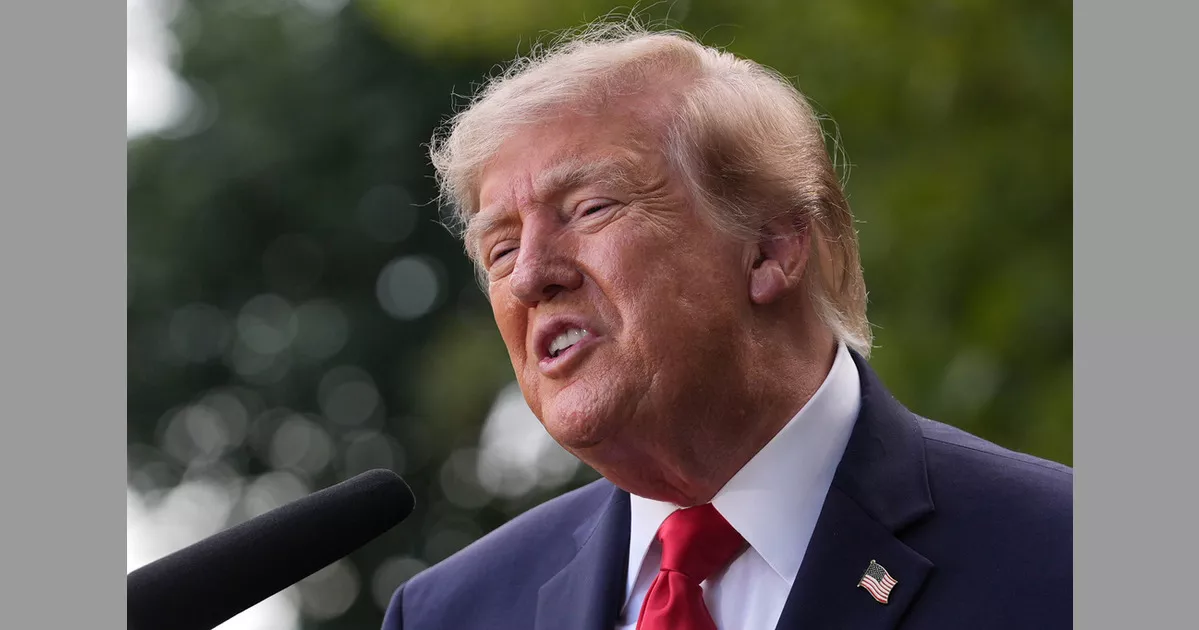
US President Donald Trump is set to address the UN General Assembly on Tuesday as the world body faces heightened global tensions over the war with Iran, growing concerns about artificial intelligence and uncertainty over the future of the United Nations.
Trump's decision to launch a war against Iran has shaken global energy markets, while his administration's reduction of US financial support for the UN has raised questions about Washington's future role in the organisation.
After his UN address, Trump is scheduled to meet British Prime Minister Andy Burnham, Japanese Prime Minister Sanae Takaichi and Venezuela's acting President Delcy Rodriguez, according to the White House.
He is also expected to meet leaders and senior officials from the Gulf Cooperation Council -- Bahrain, Kuwait, Oman, Qatar, Saudi Arabia and the United Arab Emirates -- to discuss the Iran war and recent attacks by Iran-backed rebels on Saudi Arabia.
Trump's foreign policy, particularly the decision to launch the war with Iran, has also become a political challenge for Republicans ahead of the 2026 midterm elections.
US Ambassador to the UN Mike Waltz said Trump would highlight how his administration had confronted complex global problems.
Iran war likely to dominate
Trump's speech comes nearly seven months into the US war with Iran, which he has defended as necessary to address what Washington considers an Iranian nuclear threat.
The conflict has disrupted global energy supplies despite US and Israeli strikes that have killed senior Iranian leaders and damaged Iran's military capabilities. A US blockade of Iranian oil has also severely affected the Iranian economy.
Oil shipments through the Strait of Hormuz have improved in recent weeks with US Navy assistance, but remain below pre-war levels. Brent crude has stayed around $100 a barrel, compared with about $70 before the war.
Qatar and other mediators are seeking to overcome what Qatari Foreign Ministry spokesman Majed al-Ansari described as a deep lack of trust between Washington and Tehran and revive negotiations.
US Secretary of State Marco Rubio said Trump was open to meeting Iranian President Masoud Pezeshkian during the UN gathering.
Greenland deal
The Trump administration is also expected to sign an agreement with Danish and Greenlandic leaders during the UN week to establish a framework for expanding the US military presence in Greenland.
The agreement, announced last week, followed Trump's repeated threats to take control of Greenland, an autonomous territory of NATO member Denmark, by force if necessary. Under the deal, Greenland will remain part of Denmark.
Russia-Ukraine war
Trump may also address Russia's continuing war in Ukraine, which he had pledged during his 2024 campaign to resolve on the first day of his second term.
He has expressed growing frustration over continued attacks on energy infrastructure by both sides. Trump said last week that Russia and Ukraine had agreed not to target each other's energy facilities, but the two sides have continued strikes.
Talks with UK, Japan and Venezuela
Trump's meeting with Burnham will be their first face-to-face talks since the Labour leader became British prime minister in July. Rising oil prices and disruptions around the Strait of Hormuz are expected to be among the issues discussed.
Trump will also meet Japanese Prime Minister Takaichi ahead of Chinese President Xi Jinping's planned state visit to Washington later this week.
Relations between Japan and China have become increasingly tense, including over Taiwan and economic issues.
Trump's planned meeting with Venezuela's acting President Delcy Rodriguez will be their first since the US military operation that removed former Venezuelan President Nicolas Maduro in January and brought him to New York to face federal charges.