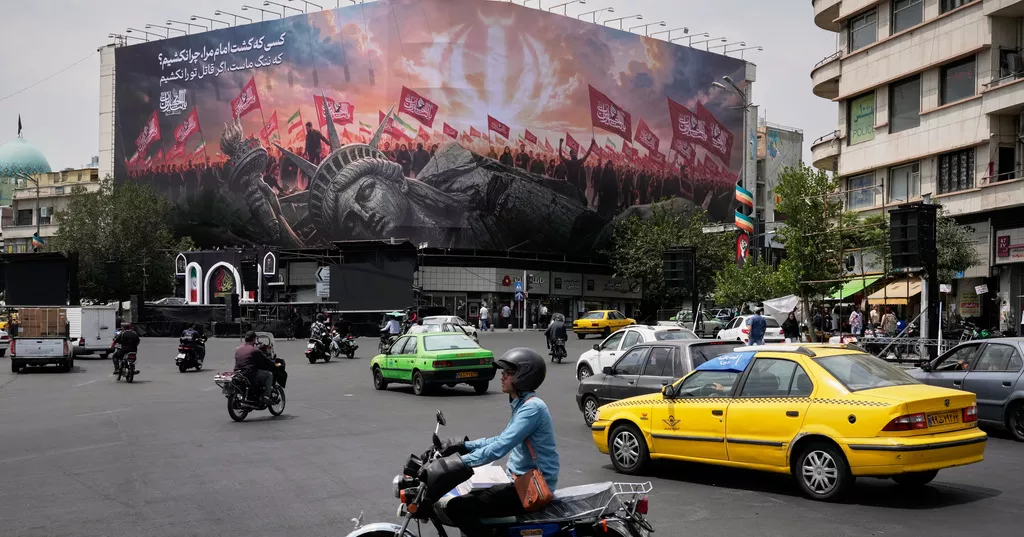
US President Donald Trump said fresh talks aimed at ending the conflict with Iran would begin on Monday after he called off a new round of military strikes, although Iranian officials insisted their current diplomatic efforts are focused on neighbouring Oman rather than direct negotiations with Washington.
Talks between the United States and Iran are seen as key to ending the months-long conflict and restoring normal shipping through the Strait of Hormuz, a vital waterway that handled about one-fifth of the world's traded oil and natural gas before the war.
However, Iran's Foreign Ministry said its current negotiations are with Oman and are limited to ensuring temporary safe navigation through the strategic strait.
Trump, who has repeatedly alternated between threatening military action and offering diplomatic solutions, said Monday that "whether Iran wants to admit it or not, we are, in fact, talking."
Meanwhile, Israel carried out fresh strikes across the Gaza Strip over the weekend, days after the US and Hamas announced they had reached an agreement for the militant group to disarm, a move seen as a possible step toward ending the war in Gaza.
Hospitals in Gaza said at least 17 people, including children, were killed in the latest Israeli strikes. One attack on a residential building in southern Gaza killed three members of the same family, including a four-year-old child, according to Nasser Hospital. The Israeli military said the strikes targeted militants.
Trump announces renewed diplomatic push
Trump said on Sunday that he had decided against launching major strikes on Iran after appeals from Gulf allies, including Qatar, Saudi Arabia and the United Arab Emirates.
According to Trump, the US military had prepared what he described as "the biggest attack since World War II," but he chose to give diplomacy another opportunity after discussions with Gulf leaders and requests from unnamed Iranian officials. He did not disclose further details about the proposed talks or who would participate.
Iran, however, denied holding negotiations with the United States.
Foreign Ministry spokesperson Esmail Baghaei said ongoing discussions are only with Oman, across the Strait of Hormuz, and are focused on establishing a temporary maritime route for safe navigation.
Trade data platform Kpler reported that nine vessels passed through the Strait of Hormuz on Sunday, with most using an Iranian-controlled route.
Responding on his Truth Social platform, Trump criticised Iran's leadership, saying it was "unbelievably duplicitous" for publicly denying talks while allegedly requesting meetings.
Iranian officials visit Iraq and Pakistan
Iranian Foreign Minister Abbas Araghchi arrived Monday in the Iraqi holy city of Najaf to attend Arbaeen commemorations, one of the largest annual gatherings of Shiite Muslims.
His visit comes as Iraq continues balancing relations between Iran and the United States, a task made more difficult following the US-Israel conflict with Iran earlier this year.
At the same time, Iran's Minister of Industry, Mines and Trade Mohammad Atabak travelled to Pakistan for talks expected to focus on easing transit bottlenecks and increasing the movement of Iranian cargo through Pakistani ports during the ongoing US naval blockade.
During the two-day visit, Atabak is scheduled to attend a meeting of the Iran-Pakistan Joint Trade Committee and meet Pakistani Prime Minister Shehbaz Sharif.
Syria, Iraq discuss regional security
Syrian interim President Ahmad al-Sharaa met Iraqi Kurdish regional President Nechirvan Barzani on Monday to discuss strengthening cooperation and improving regional security.
The meeting took place amid rising tensions following a series of drone attacks by Iran-backed Iraqi militia groups targeting US interests in Iraq, including the Kurdish region.
Last month, Syrian authorities said they had intercepted an attempt to smuggle weapons across the Iraqi border that were allegedly destined for the Iran-backed Hezbollah group in Lebanon. Hezbollah rejected the allegation.
Iran executes two convicted of spying for Israel
Iran's judiciary announced Monday that it had executed two men convicted of spying for Israel during both last year's 12-day conflict and the current war.
State-run Mizan news agency identified them as Omid Behzad and Pouria Safvat, saying they had supplied military coordinates, photographs and intelligence used in attacks on Iranian targets. The agency did not disclose where the executions took place.
Last week, Iran also publicly executed two men convicted of killing four police officers during anti-government protests in January.
Gaza heat worsens humanitarian crisis
Extreme summer temperatures are making life even more difficult for hundreds of thousands of displaced Palestinians living in makeshift tents across Gaza.
The plastic-sheet shelters trap heat during the day and offer little ventilation, forcing many families to remain outdoors for long periods.
Aid organisations, including the Norwegian Refugee Council, warned that limited access to clean water, electricity and sanitation, combined with overcrowded camps, has increased the risk of dehydration, heat-related illnesses, skin infections and diarrhoeal diseases.
"It's very hot. We can't stay inside the tents. Our tent is made of nylon," said Aida Abu Hadeesha, who was displaced from Rafah in southern Gaza.
"There is no breeze, nothing, and our kids are suffering," she said, adding that the intense heat continues throughout the night while flies and cockroaches infest the camps.