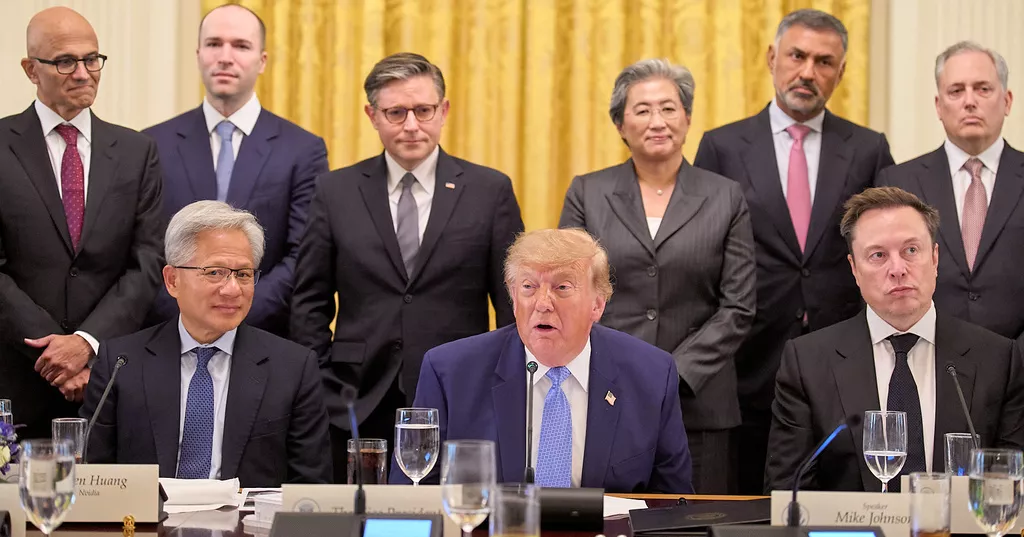
President Donald Trump said Tuesday that he and leaders of major artificial intelligence companies had signed a voluntary accord aimed at addressing public concerns over the technology, including provisions for internal and external reviews.
“I think I’m seeing tremendous self-policing. And they understand that they have to self-police,” Trump told reporters during an impromptu news conference outside the West Wing.
Trump and House Speaker Mike Johnson met with executives from leading technology companies that are investing hundreds of billions of dollars in AI infrastructure, including data centers being built in communities across the United States. The projects have sparked bipartisan opposition at the local level.
The accord was signed by Trump, Anthropic CEO Dario Amodei, Google CEO Sundar Pichai, Meta CEO Mark Zuckerberg, OpenAI President Greg Brockman, Nvidia CEO Jensen Huang and Elon Musk, founder of xAI, which is now part of SpaceX.
Trump posted the accord on his social media platform, Truth Social, late Tuesday. It leaves open the possibility of future regulation but focuses on four voluntary steps for the participating companies.
Under the agreement, the companies would establish “robust internal controls,” work with an “independent external auditor” to determine whether those controls are effective and create a committee within each company’s board of directors to review reports from internal and external auditors.
“Over time, it may make sense to codify these steps into laws and regulations,” the accord said.
Trump repeatedly praised the executives for developing a technology that he said would generate “unbelievable growth.” Investment in data centers and related computer equipment has accelerated economic activity and helped boost the stock market, increasing investment accounts for higher-income Americans and supporting consumer spending.
But some caution was voiced during Tuesday’s meeting. Amodei, one of the most outspoken advocates for slowing AI development, said the technology carries “very real risks.”
“And, you know, the mechanism, how we address those risks is still under discussion,” Amodei said.
Putting faith in ‘self-policing’ AI
Trump said about 10 people would be appointed to a committee to “watch over the whole enterprise” and described the accord as “morally binding.” He also said he would appoint someone to oversee the agreement in the coming days after consulting with industry representatives.
Some of the measures included in the accord are already being taken by the companies in some form or had previously been announced as commitments.
The agreement seeks to balance the flexibility needed for innovation with regulatory oversight, said Shri Narayanan, a professor of electrical and computer engineering at the University of Southern California.
Narayanan said innovation involves not only improving the capabilities of AI models but also making them safer and more secure.
Other experts questioned whether “so much faith” should be placed in self-policing. Robin Jia, an assistant professor of computer science at the University of Southern California, said it was important to ensure that the intentions of leading AI companies remained aligned with the broader interests of the American public.
Pointing to recent disclosures of hacking incidents, Jia said the consequences of such incidents would become more serious as AI models improve.
Some critics also objected to the accord’s broad and vague language. Alex Pascal, executive director of the Berkman Klein Center for Internet and Society, said reducing AI-related risks and harms to Americans would require legal liability, regulation and changes to the competitive pressures driving decisions by leading AI developers.
Trump unveils chatbot to help Americans navigate government services
Huang sat to Trump’s right during a White House luncheon, according to a seating chart posted by the president on Truth Social, while Musk sat to his left.
Earlier Tuesday, Trump said the U.S. government would not restrict AI development or support calls for “guardrails” and other limitations.
“I will never stifle the growth of a technology that will be bigger than the industrial revolution,” Trump said at the unveiling of an AI chatbot, America.gov, designed to help Americans navigate government services.
“We can’t stifle it, and we’re leading by a lot,” he said.
The government chatbot was unveiled during a daylong event in Washington, where several Trump administration officials celebrated what they described as a “Golden Age” driven by what Trump prefers to call “super intelligence” rather than artificial intelligence.
Secretary of State Marco Rubio said the chatbot on America.gov could soon allow people to apply for a first-time passport entirely online, eliminating the in-person visit to a processing center that is currently required.
Trump says data centers will become ‘very popular’
Trump also said the technology executives had agreed to address bipartisan opposition to data centers being built in communities across the country by providing more financial support to local schools or taking measures to lower energy costs.
“You’re going to see, data centers are going to be very popular,” Trump said. If opposition continued, he suggested, companies could be forced to build the facilities overseas or in other locations.
Also Tuesday, OpenAI CEO Sam Altman said in a television interview that the company was placing greater emphasis on safety. His company had halted the rollout of a new model the previous day over safety concerns.
“We are pacing our progress, which includes sometimes not training a model,” Altman said on CNBC. “We have to do these in a way where we can make very confident safety cases and claims, so that people don’t have a bunch of anxiety.”
Trump portrayed the global AI race as largely a competition between the United States and China, saying there would be a winner and a loser, with no “second place.”
The two countries agreed last week to establish a channel for dealing with AI-related incidents during Chinese President Xi Jinping’s visit to Washington.
Trump, however, said Tuesday that he did not want extensive cooperation with China on AI.
“I didn’t want to do anything, because we’re leading. Why would I want to do anything?” he said.